

Prompt Engineering
Roles, context, constraints, examples, and practical prompt patterns for daily work.
44 stories (23 articles · 21 videos)
Start here
A few good first pieces before you browse the full feed.
 8 min read
The anatomy of a prompt: role, context, task, constraints, format
A five-part template for making important prompts clearer, easier to review, and easier to improve. With worked examples, common mistakes, and a practical order.
Beginner 6 min read
The difference between a bad and good prompt (5 before/after examples)
Five real prompts shown in their weak version and their better version, with a short note on what changed. The fastest way to upgrade your AI output without learning any jargon.
New to AI 8 min read
Ten prompt patterns for everyday knowledge work
Ten reusable prompt shapes for drafting, critique, analysis, rehearsal, and structured output, with a validation habit for each kind of work.
BeginnerMore in this topic
 6 min read
Write the creative brief before you prompt
Prompting without a brief is asking a fluent tool to invent your project for you. A short creative brief - audience, outcome, constraints, non-goals, and taste notes - turns AI into an executor of direction you already own.
New to AI 6 min read
Iterate variants without losing the direction
Variant generation is useful until it quietly replaces your thesis with whichever option looked shiniest. A direction-locked iteration method: freeze the brief, vary one axis at a time, and kill favorites that break the core claim.
Beginner 4 min read
Workshop feedback prompts for makers
Unstructured 'be honest' prompts produce vague cheerleading or chaotic rewrites. A structured critique prompt pack for makers - clarity, structure, voice, risk - so AI workshop feedback stays useful without becoming a co-author.
Beginner 7 min read
Tutor-mode prompts: getting AI to ask questions instead of just answering
Left alone, a chatbot answers your question directly and completely, which feels efficient and teaches you very little. A small set of prompt patterns that make it hint, question, and withhold, so the productive struggle stays yours.
New to AI 7 min read
Your AI agrees with you too much: four thinking-partner failures
AI can help you examine a decision, but it also inherits your framing, rewards confident prose, and quietly encourages you to outsource judgement. Here is how to catch each failure.
Beginner 7 min read
How to make AI disagree with you honestly
Five practical prompting patterns turn agreeable AI output into a more useful challenge—without pretending that a generated counterargument is evidence.
Beginner 8 min read
Using AI to stress-test decisions: frameworks, trade-offs, and counterarguments
A four-step workflow for using AI to clarify a decision, generate alternatives, surface counterarguments, and keep uncertainty and human accountability explicit.
Beginner 10 min read
Chain-of-thought, self-critique, tree-of-thoughts — when to use each
Three reasoning techniques that can improve AI output on hard problems — and the cost-benefit tradeoffs of using them. With concrete prompts, side-by-side comparisons, and the gotchas modern reasoning models introduce.
Intermediate 12 min read
Context engineering: testing long-context systems without guesswork
Large context windows are capacity limits, not quality guarantees. Build position, distractor, retrieval, latency, and cost tests for the workload you actually run.
Advanced 8 min read
Custom instructions and memory: set up your AI once
Configure stable, non-sensitive defaults and memory controls, then review what is retained and override stale context when the task changes.
Beginner 7 min read
Few-shot prompting: steer output by example
When a description leaves room for interpretation, show the model representative input-output examples and test whether they improve consistency on your task.
Beginner 6 min read
How AI generates answers: the mental model that makes prompting click
AI does not think the way you do. It generates likely continuations from context. A plain-English mental model that, once it clicks, makes every prompting tip in the world easier to understand.
New to AI 11 min read
Multi-tool AI workflows: design reliable handoffs across tools
A practical framework for combining research, document grounding, drafting, critique, analysis, and storage while preserving provenance, privacy, and review.
Intermediate 10 min read
Choosing and prompting reasoning models
Reasoning settings change quality, latency, cost, and sometimes prompting behavior. A practical guide to choosing them by evaluation rather than folklore.
Intermediate 12 min read
Choosing between prompting, RAG, and fine-tuning (and when to combine)
Prompting, RAG, and fine-tuning are the three big levers for adapting LLMs to your problem. Each is right for some problems and wrong for others. A framework for choosing, the realistic costs of each, and the production patterns where combining them shines.
Advanced 12 min read
Designing prompts for production: system, developer, and user layers
A governance pattern for separating trusted instructions, runtime data, and user input, then versioning, evaluating, deploying, and observing prompts according to risk.
Advanced 11 min read
Building reusable prompt libraries: from snippets to shared templates
When the same AI-assisted task recurs, a prompt library can make the workflow easier to reproduce and evaluate. A practical system for capturing, testing, versioning, and sharing templates.
Intermediate 6 min read
The seven things you can ask ChatGPT on day one
The blank input box is the hardest part. Seven copyable prompts that turn an empty conversation into a real win on your very first day.
New to AI 8 min read
Stop prompting once: the iterative conversation method
A practical workflow for improving a promising first response through critique, narrowing, pivots, stress tests, and verification instead of restarting by default.
Beginner 7 min read
Writing with AI without sounding like AI
AI-assisted drafts often fall into generic patterns. Use six editing checks to recover specificity and rhythm without pretending that style alone proves who wrote the text.
Beginner 20 minutes
Google's 9 Hour AI Prompt Engineering Course In 20 Minutes
Tina Huang. A condensed run through Google's prompt engineering course covering frameworks for clarity, iteration methods, and worked examples for emails, summaries, and analysis. Useful if you want a second pass that maps the same structural ideas onto the kinds of tasks you actually hit during a workday.
Beginner 25 minutes
Prompting 101 | Code w/ Claude
Anthropic. Two members of Anthropic's Applied AI team build up a single prompt for a real customer use case (analyzing Swedish car accident reports), starting from a one-liner that fails and adding role, task context, dynamic content, examples, and final emphasis one layer at a time. It is the cleanest demonstration on YouTube of the exact "role + context + task + constraints + format" stack the article describes, with the failure modes shown along the way.
Beginner 42 minutes
Prompt Engineering Tutorial – Master ChatGPT and LLM Responses
freeCodeCamp.org. A longer, more patient course that earns its length. The chapters on best practices, zero-shot vs few-shot, and what hallucinations look like in prompted output are exactly the deepening you want once the article's five examples have clicked.
New to AI20 minutesGoogle's 9 Hour AI Prompt Engineering Course In 20 Minutes
Tina Huang. Tina condenses Google's official Prompting Essentials course into the five-part TCREI structure (Task, Context, References, Evaluate, Iterate) with worked examples on each. After the article shows you five rewrites, this hands you the recipe Google itself teaches employees, so you can do the rewrite on your own prompts without copying ours.
New to AI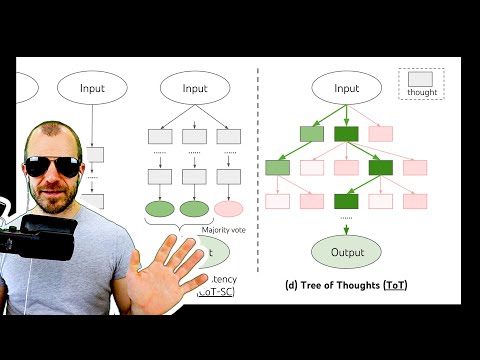 29 minutes
Tree of Thoughts: Deliberate Problem Solving with Large Language Models (Full Paper Review)
Yannic Kilcher. Yannic walks through the original Tree-of-Thoughts paper from Princeton/DeepMind — the generate-score-prune-backtrack loop, why it lifts Game of 24 accuracy from 4% to 74%, and where the technique stops being worth its 10× token cost. Useful precisely because it forces you to see ToT as a search algorithm, not a magic prompt prefix.
Intermediate25 minutesPrompting 101
Anthropic. Two members of Anthropic's Applied AI team build up a real-world prompt live, layering in role, structured sections and explicit thinking steps. It's the most credible "how to use chain-of-thought without ritualizing it" demo on YouTube, and it makes the article's "stop pasting Let's think step by step into everything" point concrete.
Intermediate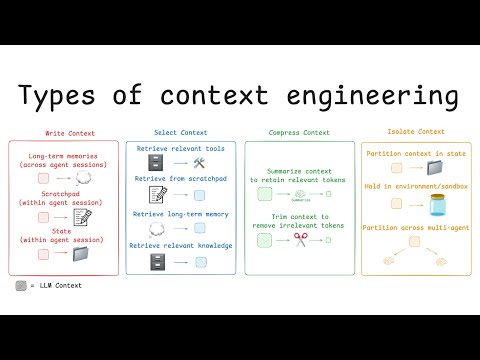 22 minutes
Context Engineering for Agents
LangChain. Lance Martin's framework — write, select, compress, isolate — with concrete examples of when to summarise an action history, when to offload state to files, and when to spin up sub-agents purely to protect the parent's context. Maps almost directly onto the article's section on managing 1M-token windows in practice.
Advanced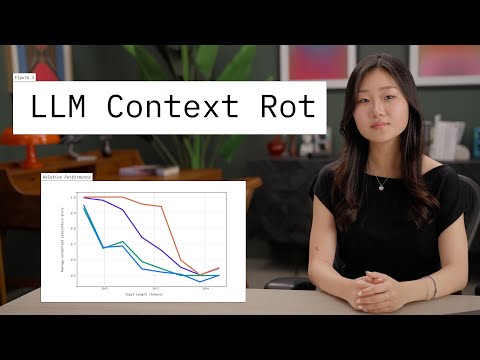 8 minutes
Context Rot: How Increasing Input Tokens Impacts LLM Performance
Chroma. Kelly Hong walking through Chroma's research on 18 models — why needle-in-haystack scores are misleading, how performance degrades with ambiguity and distractors, why even simple string-repetition tasks degrade past 500 tokens. Short, evidence-based, and exactly the case the article needs you to take seriously before getting to the engineering moves.
Advanced 131 minutes
How I use LLMs
Andrej Karpathy. Skip to the "ChatGPT memory, custom instructions" chapter at 1:53:29. Karpathy shows what he actually has in his own custom instructions, talks about when he tells ChatGPT to remember a fact versus letting it auto-capture, and notes the trade-offs — closer to the article's "set it up once with intent" framing than most beginner walkthroughs.
Beginner 36 minutes
Every ChatGPT Feature In 37 Minutes
Tina Huang. The personalization, memory, and custom instructions panels are walked through inside a wider tour of every ChatGPT feature, which is the right framing — these settings only pay off when you also know what they're configuring (projects, GPTs, scheduled tasks, voice, etc.). Use it as a guided tour while you actually open Settings → Personalization in another tab.
Beginner42 minutesPrompt Engineering Tutorial – Master ChatGPT and LLM Responses
freeCodeCamp.org. Skip to the "Zero shot and few shot prompts" chapter at 31:20 for a clean, demoed comparison of the same task with no examples versus a few — exactly the contrast the article builds the chapter around. The earlier sections on prompt mindset and best practices are useful background if you've come straight from the article without the wider context.
Beginner25 minutesPrompting 101 | Code w/ Claude
Anthropic. Examples are one of the ten ingredients Anthropic walks through here, and you can watch them get added to a real customer prompt and change the model's output. Useful if you want to see few-shot used inside a fuller prompt rather than as an isolated trick.
Beginner 3 minutes
Building OpenAI o1
OpenAI. This three-minute first-party video records how the OpenAI team presented o1 at launch. It is useful for understanding the category's history, but it does not establish how current models work internally or which prompting pattern will perform best on a different provider or task.
Intermediate 28 minutes
o1 - What is Going On? Why o1 is a 3rd Paradigm of Model + 10 Things You Might Not Know
AI Explained. The video offers an independent explanation of the early o1 framing and its prompting implications. It is useful historical context, but its claims about o1 should not be extended automatically to later OpenAI models, R1, Claude thinking modes or other providers.
Intermediate 77 minutes
AI prompt engineering: A deep dive
Anthropic. Four Anthropic prompt engineers (research, alignment, applied, developer relations) talking at length about what they actually do day to day — how they edit prompts under pressure, how they think about "honesty" in instructions, when XML scaffolds help, when they don't. The article's layered model maps cleanly onto how they describe the work; this is the best way to hear that mental model out loud.
Advanced25 minutesPrompting 101 | Code w/ Claude
Anthropic. A live build session by Anthropic's Applied AI team on an insurance-claims prompt — they start with a vague instruction and iterate to something a developer would actually ship, showing the kind of revisions the article describes for the system and developer layers. Watch this before re-reading the article's checklist on examples, output structure, and refusal handling.
Advanced 10 minutes
The best ChatGPT Prompt I've ever created - I spent 2 months curating this prompt to write prompts
Lawton Learns. The video demonstrates a C.R.A.F.T. meta-prompt (Context, Role, Action, Format, Target audience). It is a useful candidate for testing how a prompt-generating prompt behaves, but its outputs are not guaranteed to be consistent, correct or suitable for a team's use cases.
Intermediate20 minutesGoogle's 9 Hour AI Prompt Engineering Course In 20 Minutes
Tina Huang. Tina presents a five-part task/context/references/evaluate/iterate framework and four named iteration moves. Those elements can help you draft a candidate schema, but the agent and chain-of-thought examples reflect the course's time and context. Test any extracted pattern on representative cases before adding it to an approved library.
Intermediate131 minutesHow I use LLMs
Andrej Karpathy. Karpathy walks through his actual day-to-day use across ChatGPT, Claude, Gemini, Grok, and Perplexity, screen-sharing live conversations rather than polished one-shots. You see when he reaches for a follow-up, when he switches models mid-thread, and when he abandons a line and starts over — exactly the iterative loop the article describes, modeled by someone who builds these systems for a living.
Beginner 9 minutes
Master the Perfect ChatGPT Prompt Formula (in just 8 minutes)!
Jeff Su. Six-part formula — task, context, exemplars, persona, format, tone — explained with office-work examples such as workout plans, resumes, and internal emails. It provides a compact frame that overlaps with several of the article's patterns.
Beginner 26 minutes
Every Essential AI Skill in 25 Minutes (2025)
Tina Huang. The prompting chapter (02:30–09:20) lays out two stackable mnemonics — "tiny crabs ride enormous iguanas" (task, context, references, evaluate, iterate) and "ramen saves tragic idiots" (revisit, separate, try analogous, introduce constraints) — that map cleanly onto the iterate-and-refine patterns in the article. Useful when a single-shot formula isn't getting you there.
Beginner