
Courses
We don't run courses ourselves. Instead we hand-pick useful external courses and learning resources for each level — from a calm first introduction to deep technical depth. Every link below is free, starts free, or can be audited for free, and we check that it is still relevant today.
Refine15 results
AI for Everyone
Six years after it launched, still the cleanest starting point for anyone who needs to understand AI without learning to code. No math, no jargon, no hype — you'll finish able to have an informed conversation about AI projects.
Google AI Essentials
The most pragmatic, workplace-flavoured first course. Where Andrew Ng's "AI for Everyone" gives you the mental model, Google's course shows you what to actually do tomorrow morning — speeding up everyday tasks, drafting, brainstorming. Zero coding, five short modules including a vital chapter on responsible use.
Generative AI for Everyone
Real time inside an LLM, learning to prompt deliberately and recognise where generative AI is genuinely useful versus where it's a trap. Calm, no-hype teaching — the perfect bridge from "I've tried ChatGPT once" to "I use it every day with confidence."
ChatGPT: Excel at Personal Automation with GPTs, AI & Zapier
The clearest path from "I use ChatGPT in a tab" to "my AI handles my inbox while I sleep." Three-course specialization built around Zapier — no Python required. By the end you'll have agents that summarise emails, update spreadsheets, and trigger workflows when conditions are met.
Prompt Engineering for ChatGPT
The academic complement to DeepLearning.AI's short course — same discipline, longer arc, written for people who don't code. Dr. White teaches prompting as a set of reusable patterns (Ask for Input, Outline Expansion, Fact Check List, Menu Actions) rather than tricks. After this you'll prompt LLMs like a designer, not a guesser.
ChatGPT Prompt Engineering for Developers
Ninety minutes to a year's worth of intuition. If you've started writing code that calls an LLM — or you're about to — this is the most efficient course online for closing the gap between "playing with ChatGPT" and "shipping a feature that calls an LLM."
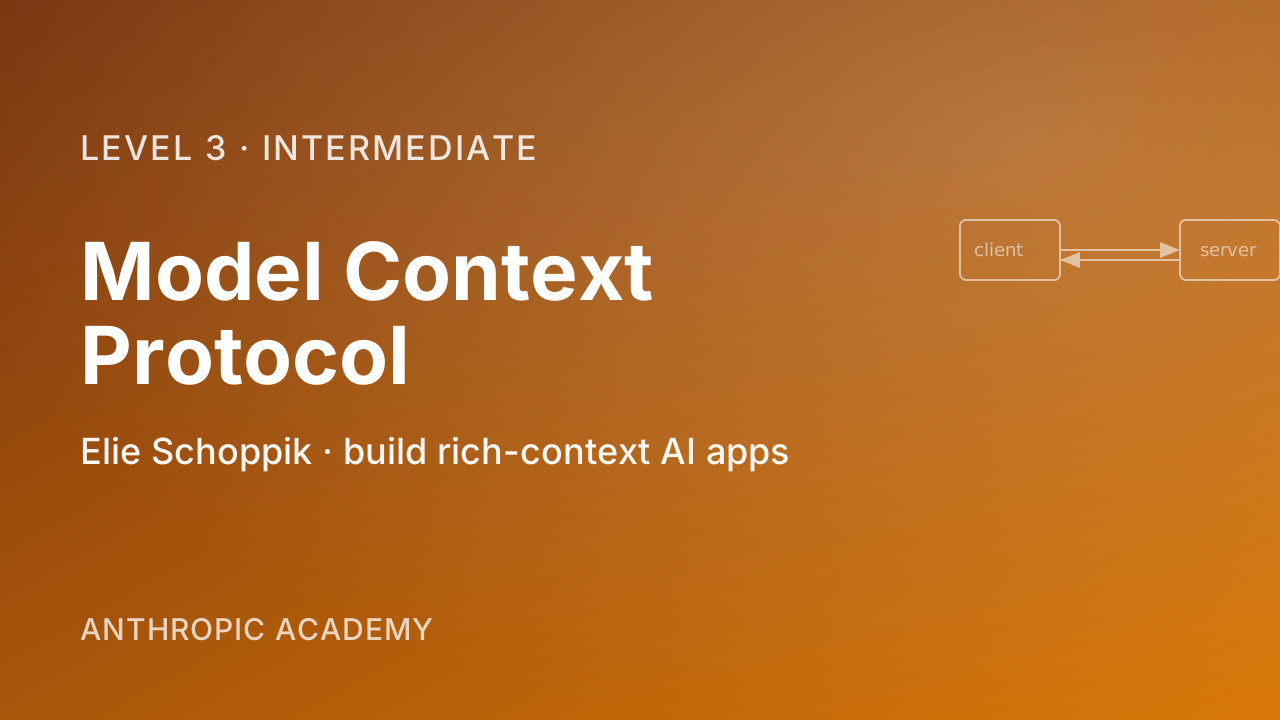
MCP: Build Rich-Context AI Apps with Anthropic
MCP is the protocol that's quietly replacing one-off tool integrations across the AI tooling ecosystem. Learn it from the source. By the end you'll have built and deployed your own MCP server, connected an LLM client to it, and understood why this standard is the closest thing the field has to USB-C.
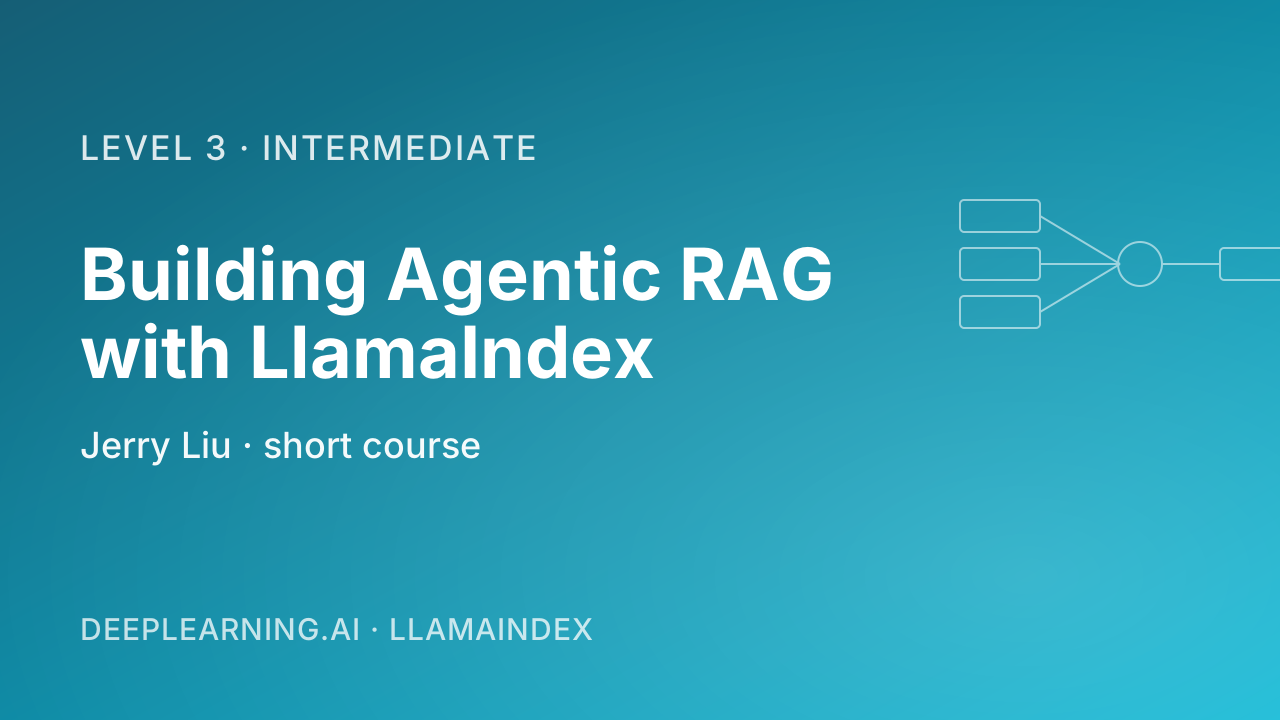
Building Agentic RAG with LlamaIndex
Naive RAG (vector search → stuff into prompt) is the version that ships first and disappoints fastest. This short course shows you the upgrade: an agent that plans retrieval, picks tools, compares sources, and answers multi-document questions. Two hours, immediately applicable to a real product.
AI Agents Course
The clearest open-source treatment of agentic systems available. Anchored in the three frameworks engineers actually evaluate (smolagents, LlamaIndex, LangGraph) rather than one vendor's stack. Concludes with a benchmark assignment and public leaderboard — accountability your team can verify.
Long-Term Agentic Memory with LangGraph
The context-window-amnesia problem is what makes most agents feel forgetful and dumb on day two. This course teaches the LangMem patterns that fix it — episodic, procedural, and semantic memory — so an agent remembers user preferences and past interactions across sessions without bloating the prompt.
Practical Deep Learning for Coders
Selected for its top-down pedagogy. Most ML courses spend three weeks on calculus before you train anything; Fast.ai has you classifying images in the first lesson and peels back the layers from there. Recommended for developers who want to write PyTorch and debug live models — not study abstract maths first.
Generative AI with Large Language Models
When practitioners ask "what should I take if I'm serious about building with LLMs?", this is the answer. Mathematically honest without being a research paper; AWS-flavoured deployment chapters stay useful even if you'll never touch SageMaker.
AI & EU Law: Definition and Developments
The fastest credible briefing on what the AI Act actually says — written by the institute that trains EU civil servants. Forty-five minutes; covers the risk-tier classification, who's responsible for what, and what changes for your product roadmap. The single best starting point for EU-deployed AI systems.
Generative AI: Governance, Policy, and Emerging Regulation
Few courses survey the regulatory landscape across the US, EU, and G7 in one place; this one does. Useful for compliance officers and product leaders trying to ship into multiple jurisdictions without inheriting hidden legal exposure. Pairs well with the EIPA EU AI Act primer for the European-specific detail.
AI Strategy and Governance
Wharton's rigorous framing for executives making build-vs-buy decisions. Cuts through vendor pitches by focusing on the economics of AI deployment, algorithmic bias in hiring and operations, and the governance practices that survive an audit. Best taken before, not after, your next major AI procurement decision.
These links point to third-party learning providers and official resources. We have no commercial relationship with them — we recommend each one because it fills a clear learning need.