
Most weak AI-assisted creative work does not fail because the model is “bad at art.” It fails because the human never decided what the piece was for. A vague prompt (“make something cool for my launch”) forces the model to invent audience, tone, constraints, and success criteria. You then edit around those invented defaults and wonder why the result feels generic.
This article teaches one habit: write a brief first. It sits beside AI is not your muse (taste and judgment stay yours) and ahead of the practitioner pieces on critique loops and variants. For the wider stage map of a creative practice, see keep your taste.
Why a brief beats a clever prompt
A prompt is an instruction to a generator. A brief is a decision record for you. The brief answers questions the model should not be allowed to answer for you:
- Who is this for?
- What should change for them after they encounter the work?
- What must stay true (facts, brand, medium, length, budget)?
- What is explicitly out of scope?
- What does “good” look like in your taste - not in the model’s average?
Professional creative industries already treat the brief as the control surface for human teams. Generative tools do not remove that need; they make skipping it more tempting, because fluent output arrives even when the brief is empty.
Put the brief in a document you control. Paste into the model only the fields the task needs. Client names, embargoed claims, and unpublished strategy belong behind the same paste discipline as other work secrets (do not paste work secrets).
The five-field brief
Copy these fields before you open a chat:
- Audience - one concrete group, not “everyone.”
- Outcome - one change in understanding, feeling, or action.
- Constraints - medium, length, deadline, brand rules, accessibility needs, legal limits.
- Non-goals - what you will refuse even if the model suggests it (hype tone, style imitation, competitor swipe, therapy framing).
- Taste notes - three words or a reference to your prior work that should remain recognizable.
Illustrative scenario: a potter launching a weekend workshop page. Audience: beginners who fear “ruining clay.” Outcome: they book a slot feeling the class is patient, not elite. Constraints: 180 words, no stock photo of a celebrity ceramicist, price listed once. Non-goals: “transform your life” language; AI images of hands that are not theirs. Taste notes: warm, specific, slightly dry humor - like their last three Instagram captions.
That brief fits on half a page. It also gives you a rejection test: any model output that violates a field is wrong, even if it sounds polished.
Common misconceptions
“I’ll know it when I see it.” That is a taste process, not a brief. You can still browse variants after the five fields exist. Without them, “I’ll know it” becomes endless generation.
“The client brief is enough.” Client briefs often describe deliverables, not your authorship and taste boundaries. Add fields 4 and 5 yourself.
“Prompts replace briefs.” A long prompt that still asks the model to invent the audience is a brief-shaped hole. Length is not ownership.
How to use the brief with a model
Once the five fields exist:
- Paste only what the tool needs (often outcome + constraints + taste notes).
- Ask for options that respect the brief, not options that rewrite it.
- Score each option against the five fields before you fall in love with a sentence.
- Keep a short change log when you revise the brief - so the project does not silently drift.
For text that must still sound like you, pair this with writing with AI without sounding like AI. For tasks you should not hand over at all, use what not to delegate to AI.
Client creative briefs often contain unreleased product names, launch dates, and competitor notes. Treat them as confidential. Prefer redacted briefs in consumer tools; use contracted enterprise tooling when your client or employer requires it.
Authority anchors (why ownership matters)
If the finished work will be registered, licensed, or disputed, keep a record of your human contribution. The U.S. Copyright Office’s registration guidance requires disclosing more than minimal AI-generated content and limiting authorship claims to human-authored portions (Copyright Registration Guidance: Works Containing Material Generated by Artificial Intelligence, 2023). The same office’s copyrightability analysis centers human authorship of the expressive elements you claim (Copyright and Artificial Intelligence, Part 2: Copyrightability Report, January 2025). A dated brief plus your drafts is practical evidence of that human direction - not legal advice, but better provenance than a chat history full of “make it cooler.”
In the EU, transparency duties for certain AI interactions and synthetic content sit under the AI Act’s Article 50 timeline (Regulation (EU) 2024/1689; Commission FAQ on dates and roles); if you publish for EU audiences, plan disclosure separately from the brief habit - see the later article on disclosing AI in creative credits.
WIPO’s overview of generative AI and intellectual property likewise stresses clearance, human contribution, and uncertainty rather than casual confidence that a prompt equals ownership (WIPO, Generative AI: Navigating Intellectual Property). Treating the brief as a governed decision record also fits how NIST frames AI risk management: map the context, document how you will use the tool, and keep a human accountable for outcomes (NIST AI Risk Management Framework).
Shown input and output pattern
Brief excerpt (illustrative):
Audience: parents booking a first pottery class for themselves, not for kids.
Outcome: they feel the studio is calm and adult, then email to reserve.
Constraints: 120-150 words; no "unleash your creativity"; price EUR 65 named once.
Non-goals: therapy language; celebrity-artist name-drops; AI hand stock images.
Taste notes: dry humor, concrete studio details, short sentences.
Prompt after the brief:
Using only the brief above, draft two homepage blurbs.
Flag any sentence that violates non-goals or taste notes.
Do not invent new audience segments.
A useful model reply (illustrative composite): two drafts that stay inside length, plus a flag that “find yourself in clay” violates the therapy non-goal. That flag is the brief working. Without the brief, the same model often produces the flagged line as a feature.
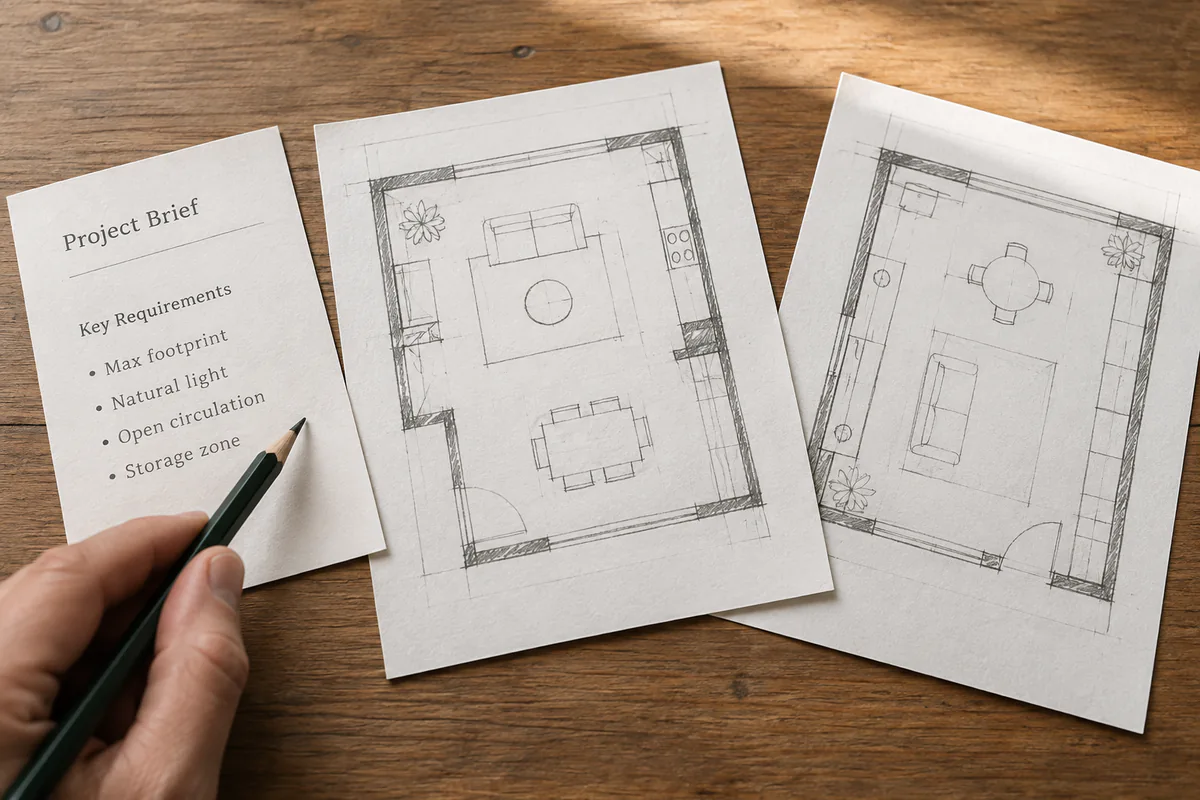
For image or layout work, the same five fields still apply; only the constraint line changes (aspect ratio, print size, color limits). The later article on visual references without style theft covers ethics once references enter the brief.
Brief anti-patterns
- Mood-board theater: fifty reference images and no outcome sentence.
- Committee brief: twelve stakeholders, no named decision-maker for taste conflicts.
- Secret constraints: non-goals that exist only in your head, so the model keeps offering them.
- Therapy-by-prompt: asking the model to tell you what your art “means for your healing.” That is outside this category’s job - keep the brief about audience, outcome, and craft.
Write the brief once, then prompt
Take one piece you planned to “just prompt.” Fill the five fields on the creative brief worksheet without opening a model. Only then generate. If you cannot fill a field, that is the real blocker - not a missing prompt trick.