

Creativity & Craft
Decide which creative stages to accelerate and which to keep deliberately human.
15 stories (15 articles · 0 videos)
Start here
A few good first pieces before you browse the full feed.

More in this topic
 3 min read
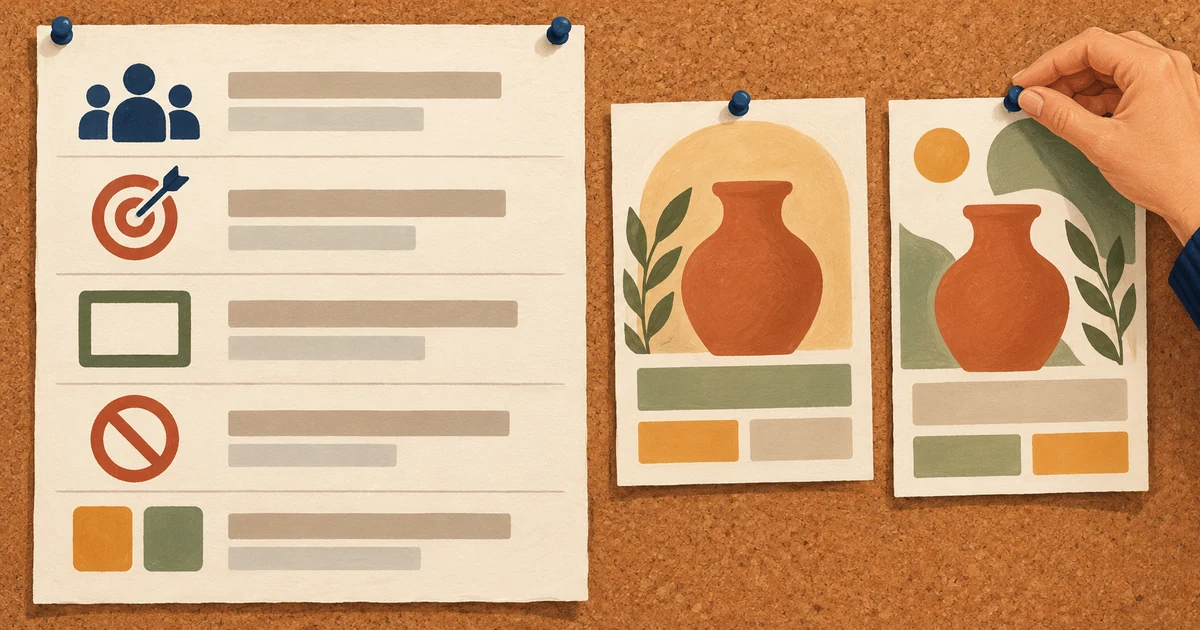
Write the creative brief before you prompt
A five-field brief makes creative direction visible. Compare two options against the same audience, facts and constraints, then change the brief deliberately if you learn something.
New to AI 5 min read
Disclose AI in creative credits without the panic
When does AI assistance need a credit line, and how do you write one that is honest without turning the artwork into a disclaimer wall? Practical disclosure norms for makers, aligned with authorship rules and emerging transparency duties.
Beginner 6 min read
Draft first, then ask for critique — not co-authorship
The strongest AI assist for makers is usually critique of a draft you already wrote — not a co-authored first draft that quietly replaces your voice. A draft-then-critique loop with validation rules and a clear fallback when the feedback is generic.
Beginner 5 min read
An edit pass that preserves your taste
AI edit passes often sand your work toward the mean. A taste-preserving edit loop: criteria first, local suggestions only, side-by-side keep/reject, and a final unaided read that protects what makes the piece yours.
Intermediate 6 min read
Iterate variants without losing the direction
Variant generation is useful until it quietly replaces your thesis with whichever option looked shiniest. A direction-locked iteration method: freeze the brief, vary one axis at a time, and kill favorites that break the core claim.
Beginner 6 min read
Visual references: describe the craft, check the rights
Reference images and artists are how makers learn, and how generative tools get misused. A consent-aware, fair-reference practice for AI image work that refuses living-artist style cloning while still letting you study craft.
Beginner 6 min read
Get consent before synthetic voice or likeness in a project
Project hygiene for makers who want synthetic voice, face, or performance elements: consent first, scope in writing, storage limits, and clear refusal paths - without a cloning how-to.
Beginner 4 min read
Keep your name on AI-assisted work
Check the rules governing the actual work, describe AI assistance accurately, and retain accountable ownership. Copyright registration, publisher, school, client and repository policies have different disclosure requirements.
Beginner 6 min read
Raise children who remain authors of their own lives
App-level screen time rules answer 'how much AI.' They do not answer the harder question: which of the choosing, deciding, creating, and relating that childhood is for should stay a child's own, even as AI becomes ambient in homework, friendship apps, and games. A practice framework across six domains gives families and schools a decision rule, not just a time limit.
Intermediate 5 min read
Refuse to rank people with AI
It is tempting to ask AI to score candidates, rank a team, or rate who is the 'best' friend, employee, or date. Named laws and documented failures show how opaque scoring can encode bias and remove accountability. A refusal checklist for everyday life and work.
Beginner 4 min read
Why repair and apology stay human
AI can help you find the words for an apology you are struggling to write. It cannot take responsibility for the decision to apologize or do the ongoing work of repair that makes an apology mean anything. A checklist keeps AI in the drafting role and the relational accountability where it belongs: with you.
Beginner 6 min read
What deteriorates when you outsource thinking
Letting a model start every essay, email, and argument can remove opportunities to practise starting them yourself. A skill-preservation audit (baseline, unaided attempt, assisted phase, independent check) makes that trade-off visible without claiming permanent cognitive decline.
Beginner 8 min read
The delegation audit: what should stay yours
AI can draft, summarize, and organize almost anything you hand it. That does not mean it should. A six-question delegation audit — consequence, authorship, relationship, skill, privacy, reversibility — sorts tasks into keep, assist, delegate, and never, with ten worked examples.
New to AI 8 min read
The dignity of work when machines can do more of it
A practical job-redesign assessment for SME leaders: examine worker voice, retained judgement, skill paths, workload, monitoring, and appeal before declaring an automation successful.
Intermediate