


Most AI “edit this” prompts optimize for smoothness. Smoothness is not the same as quality, and it is often the opposite of taste. The sentences that make a piece recognizable - the slightly crooked metaphor, the abrupt cut, the specific proper noun - are the first things a generic edit pass sandblasts away.
This is the intermediate edit loop for makers who already know the stage map in keep your taste and the drafting order in draft then critique. It also leans on the tell list in writing with AI without sounding like AI.
Scenario
Illustrative scenario: a designer writes a sharp, slightly sarcastic case study. An unchecked edit pass returns a LinkedIn-friendly version with “I’m excited to share” energy. The craft errors are gone. So is the reason clients hire that designer.
Principles of a taste-preserving pass
- Criteria before paste. Name what “better” means for this piece.
- Local, not global. Ask for notes or alternate lines for marked spans - not a full rewrite.
- Keep a side-by-side. Never overwrite the only copy.
- Oddness is evidence. If a suggestion removes a specific detail “for flow,” treat that as a smell.
- Final read unaided. You, preferably out loud, without the model in the room.
Step-by-step loop
Step 0 - Freeze what must survive
Write five “preserve” bullets: tone words, a must-keep anecdote, banned corporate phrases, structural choices you already love, audience promise from the brief (creative brief).
Step 1 - Mechanical pass (optional, narrow)
Ask only for typos, broken grammar, and unclear antecedents. Ban tone changes.
Check only spelling, grammar, and unclear pronouns.
List fixes as line notes. Do not rewrite for style.
Preserve these intentional choices: [preserve bullets].
Step 2 - Craft pass
Against criteria: [clarity / pacing / repetition / evidence],
point to weak spans with quotes.
Offer at most one alternate sentence per weak span.
Do not produce a full alternate essay.
Step 3 - Voice defense pass
Here are 3 samples of my prior published voice: [samples].
Flag any sentence in the edited draft that drifts toward generic AI tells
(filler openings, hedged endings, metronomic rhythm, empty verbs).
Quote them. Do not "fix" by rewriting the whole piece.
Step 4 - Human merge
In your editor, accept or reject each suggestion individually. If you accept more than roughly a third of stylistic suggestions (rule of thumb, not a measured law), slow down - you may be surrendering taste.
Step 5 - Unaided cold read
Print or read on a clean device, preferably out loud. If it no longer sounds like you, roll back to the pre-pass draft and take fewer suggestions.
Keep versions named
draft,edit-pass-notes,merged. Chat is not version control. Provenance matters if you later need to show human authorship for registration (U.S. Copyright Office registration guidance). Purely generative stretches still sit under the Copyright Office’s human-authorship analysis (Copyrightability Report, Jan 2025).
Edit passes on unpublished manuscripts, client decks, or personal essays still send content to a vendor. Redact secrets and third-party private details first (work secrets; photo consent when images are in the file).
Validation table
| Check | Pass signal | Fail signal |
|---|---|---|
| Specificity | Proper nouns and sensory detail remain | Abstractions into “various challenges” |
| Rhythm | Sentence length still varies | Even, polite cadence throughout |
| Stance | You still take a position | Hedged non-conclusions |
| Authorship | You can defend every claim | Model-invented anecdotes slipped in |
Automation bias is the enemy here: fluent suggestions feel correct (Mosier et al., 1998). Your job is to keep checking. NIST’s AI Risk Management Framework likewise treats documented context and human oversight as part of trustworthy use - an edit pass included (NIST AI RMF).
Fallback
If the model cannot stop rewriting, switch tools or go offline. A human editor with your preserve list beats a model that ignores constraints. For strategic decisions about when public prose must stay fully yours, continue to refuse to ghostwrite your voice.
Shown before/after (illustrative)
Original line the maker wants to keep:
The glaze crawled like a bad rumor across the lip of the bowl.
Unchecked “edit for professionalism” output:
The glaze showed an uneven application along the rim of the bowl.
Taste-preserving alternate offered only after a craft note:
Craft note: "bad rumor" is figurative; keep if voice allows, or replace with a
concrete physical verb if this piece must stay literal for a technical audience.
Optional literal alt: "The glaze beaded and tore along the lip."
The maker keeps the rumor line for a personal essay and takes the literal alt for a process blog. Same model, different criteria. That is the point of Step 0.
Relationship to disclosure
A heavy edit pass can push a piece into “appreciable AI assistance” territory even when you drafted first. If the published voice owes clear debts to generated alternate sentences, add a credit (disclose AI in creative credits). Publishing-ethics bodies reject listing AI as an author because a tool cannot take responsibility (COPE on authorship and AI tools). For EU-facing releases, plan transparency for in-scope synthetic content under AI Act Article 50 (Regulation (EU) 2024/1689; Commission FAQ). Do not use disclosure as permission to ship a sanded-down self.
Common failure modes
- Asking “make this better” with no preserve list
- Accepting every alternate sentence because it sounds “clean”
- Editing the only copy inside the chat window
- Letting the model invent connective anecdotes to “improve flow”
- Skipping the unaided cold read because the deadline is close
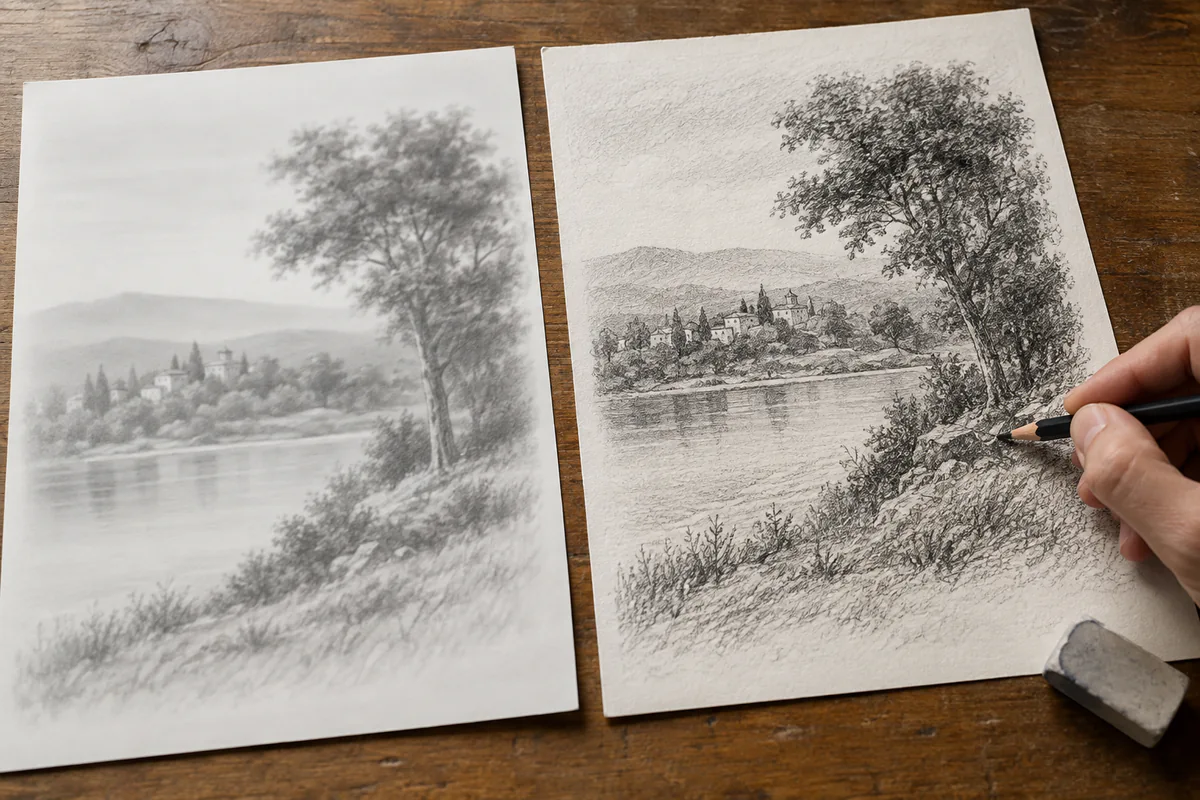
Compare two edit passes side by side
Run the loop on one section only. Produce (1) a mechanical+craft merge and (2) an unchecked “edit this whole thing” merge. Read both beside the original using the taste-preserving edit pass worksheet. Keep the version that still sounds like you - even if it is less smooth.