

AI Security
Prompt injection, leakage, unsafe tool access, permissions, and production failure modes.
19 stories (12 articles · 7 videos)
Start here
A few good first pieces before you browse the full feed.
 14 min read
Prompt injection and LLM security: threat models and defense-in-depth
Prompt injection is a permanent LLM security class, not a prompt-writing mistake. A production guide to threat models, data boundaries, tool permissions, regression tests, monitoring, and incident response.
Advanced 10 min read
Company knowledge RAG: permissions, leakage, and source boundaries
A company knowledge assistant is only safe if retrieval respects permissions. How to design RAG source boundaries, ACL filtering, document ownership, logging, stale-source handling, and refusal behavior.
Advanced 11 min read
Secure document ingestion for RAG: PDFs, OCR, metadata, and retention
RAG quality starts before retrieval. A secure ingestion guide for PDFs, OCR, metadata, permissions, source freshness, deletion, malware risk, and operational ownership.
AdvancedMore in this topic
 7 min read
Hermes webhooks: event-driven agents without a giant catch-all prompt
Configure Hermes Agent webhooks with provider-appropriate authentication, health checks on port 8644, and small named routes, so events become focused agent runs with an explicit delivery target.
Intermediate 10 min read
NemoClaw on DGX Spark: deployment and security plan
Plan and evaluate OpenClaw, Hermes, or Deep Agents Code inside NVIDIA OpenShell on DGX Spark: current onboarding, policy layers, routed inference, and required acceptance evidence.
Advanced 8 min read
OpenClaw allowlists, pairing, and group mention security
Channel allowlists, DM pairing, and group mention rules are the real security boundary for OpenClaw — because tools can include shell, files, and browser. A practical lockdown checklist.
Intermediate 9 min read
OpenClaw personal gateway setup: install, onboard, dashboard
What OpenClaw is, how to install and onboard the self-hosted multi-channel gateway, open the Control UI on port 18789, and which Node versions are supported without skipping the security baseline.
Intermediate 10 min read
OpenClaw skills, heartbeat autonomy, and approval gates
How OpenClaw skills load, how heartbeat periodic turns work, how to gate host shell execution, and how to keep browser automation behind restrictive policy and reviewed workflow confirmation.
Intermediate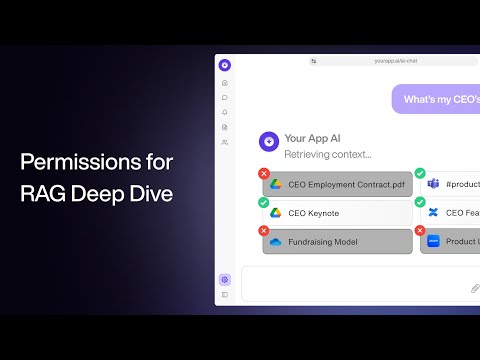 20 minutes
Permissions & Access Control for RAG - a Deep Dive Tutorial
Paragon. Walks through the production RAG permission problem and compares tool-calling, namespaces, ACL tables and relationship-based permissions. That directly supports the article's core rule: retrieval must only return sources the current user is allowed to see, and source-system permissions cannot be treated as an afterthought.
Advanced 69 minutes
The Agent Landscape - Lessons Learned Putting Agents Into Production
MLOps.community. Prosus's VP of AI and an AI engineer report what actually broke when they deployed agents across the group's portfolio companies: prompt-injection pen-testing before launch, an unsafe write when a Jira agent choked on human shorthand, stale context handled by making agents surface their assumptions, and fallback design that merged or killed agents once they added cognitive load. It reads like the article's failure-mode register replayed as a live postmortem.
Advanced 7 minutes
Unlock Better RAG & AI Agents with Docling
IBM Technology. Explains the ingestion side of RAG and agents: preparing PDFs and other files so document structure, tables and layout survive into downstream retrieval. That supports the article's warning that RAG quality and safety begin before embedding, especially when parsing complex business documents.
Advanced 10 min read
Production AI failure modes: what breaks after the demo
Build a failure-mode register for hallucination, stale context, prompt injection, unsafe tool use, schema drift, weak fallback, and observability gaps.
Advanced 10 min read
Private AI deployment patterns: local, VPC, self-hosted, and hybrid
Private AI is not one architecture. A practical comparison of local models, enterprise SaaS, VPC deployments, self-hosted inference, and hybrid patterns for SMEs that care about privacy and control.
Advanced 10 min read
Connecting AI to your email, calendar, and CRM safely
A risk-based guide to connecting AI with email, calendar, and CRM using minimum scope, approval gates, protected audit evidence, negative tests, and recovery paths.
Intermediate 8 min read
Privacy and data hygiene when using AI at work
A practical guide to reducing privacy and confidentiality risk when using AI at work. Check the exact product, plan, configuration, data, and applicable rules before you paste.
Beginner 25 minutes
OWASP's Top 10 Ways to Attack LLMs: AI Vulnerabilities Exposed
IBM Technology. Zooms out from prompt injection to the wider OWASP Top 10 for LLMs — insecure output handling, sensitive information disclosure, excessive agency — which is exactly the failure-mode catalogue you want in mind before you grant Gmail or HubSpot scopes to anything.
Intermediate 11 minutes
What Is a Prompt Injection Attack?
IBM Technology. Jeff Crume's "buy an SUV for $1" example is the cleanest 10-minute explanation of why direct and indirect prompt injection are different problems, and why filtering can't fully solve either. It pairs directly with the article's argument that you need least-privilege scopes, a dedicated agent account, and a human in the loop on anything irreversible — not a cleverer system prompt.
Intermediate 13 minutes
Attacking LLM - Prompt Injection
LiveOverflow. Frames prompt injection as a classic injection attack against systems that mix instructions and untrusted data — with a concrete content-moderation example where an attacker frames an innocent user. The mental shift from "the model is the target" to "the application is the target" is exactly the move the article opens with.
Advanced 17 minutes
Defending LLM - Prompt Injection
LiveOverflow. Walks through the actual defence-in-depth playbook — taint analysis on LLM output, restricting expected output shapes, user isolation, few-shot scaffolds, fine-tuning, temperature 0 for determinism, redundancy for critical paths. It matches the article's defence-stack section almost item for item.
Advanced