

Agents & Computer Use
Agent workflows, browser control, memory, loops, frameworks, and customer-facing voice flows.
48 stories (29 articles · 19 videos)
Start here
A few good first pieces before you browse the full feed.
 11 min read
Build your first AI agent in n8n: a lead-triage workflow end-to-end
A documented n8n lead-triage design: validate input, constrain agent tools, validate structured output, persist an atomic proposal, and keep every customer-visible action behind approval.
Intermediate 11 min read
Browser agents and computer use: what they can actually do today
Browser agents and computer-use AI promise to operate your computer the way you do. The reality in 2026 is more useful and more limited than the demos suggest. A grounded guide to what works, what doesn't, and where to apply them.
Intermediate 13 min read
Designing agents that don't loop forever
Infinite or pseudo-infinite loops are a costly agent failure mode. This guide shows how to bound work, detect lack of progress, and terminate safely.
AdvancedMore in this topic
 9 min read
DGX Spark: what it is, who it is for, and what changed for local agents
A grounded read of NVIDIA DGX Spark: Grace Blackwell GB10 specs from NVIDIA, coherent unified memory, ConnectX-7 clustering, and when a desk-side agent computer is the right private AI bet.
Advanced 7 min read
Hermes Agent: what it is, what it isn't, and when to use it
A clear map of Hermes Agent from Nous Research: persistent memory, skills, tools, and messaging gateways, plus the decision of when a chatbot is enough and when an agent runtime is the right tool.
Intermediate 8 min read
Hermes Agent first week: memory hygiene, skills, and tool approvals
A safe first-week setup for Hermes Agent: install and smoke-test, curate MEMORY.md and USER.md, add one skill, bound file writes, and disable or isolate shell access.
Intermediate 8 min read
Hermes vs n8n: choose by the job (and when to use both)
A decision framework for Hermes Agent versus n8n: deterministic plumbing stays in n8n, while a bearer-authenticated Hermes API step or a separate event-webhook path handles bounded agent work.
Intermediate 7 min read
Hermes webhooks: event-driven agents without a giant catch-all prompt
Configure Hermes Agent webhooks with provider-appropriate authentication, health checks on port 8644, and small named routes, so events become focused agent runs with an explicit delivery target.
Intermediate 8 min read
Idempotency, retries, and human gates for n8n AI nodes
AI nodes fail differently from CRUD APIs. Design n8n retries, idempotency keys, human-in-the-loop gates, and logging so a flaky model call does not double-send email or skip review.
Intermediate 10 min read
n8n → Hermes: choose an API call or an event webhook
Keep deterministic state in n8n and choose the Hermes API when n8n needs an agent result, or the webhook adapter when an event should trigger a configured Hermes delivery.
Intermediate 10 min read
NemoClaw on DGX Spark: deployment and security plan
Plan and evaluate OpenClaw, Hermes, or Deep Agents Code inside NVIDIA OpenShell on DGX Spark: current onboarding, policy layers, routed inference, and required acceptance evidence.
Advanced 8 min read
OpenClaw allowlists, pairing, and group mention security
Channel allowlists, DM pairing, and group mention rules are the real security boundary for OpenClaw — because tools can include shell, files, and browser. A practical lockdown checklist.
Intermediate 9 min read
OpenClaw personal gateway setup: install, onboard, dashboard
What OpenClaw is, how to install and onboard the self-hosted multi-channel gateway, open the Control UI on port 18789, and which Node versions are supported without skipping the security baseline.
Intermediate 10 min read
OpenClaw skills, heartbeat autonomy, and approval gates
How OpenClaw skills load, how heartbeat periodic turns work, how to gate host shell execution, and how to keep browser automation behind restrictive policy and reviewed workflow confirmation.
Intermediate 8 min read
OpenClaw vs Hermes: choose by the job, not the brand
OpenClaw and Hermes are overlapping self-hosted agent systems with different operational strengths. Compare channel routing, webhooks, tools, and automation boundaries before choosing either or both.
Intermediate 10 min read
Experimental dual-DGX Spark + DeepSeek-V4-Flash + n8n + Hermes stack
How to evaluate an experimental community dual-DGX Spark path for DeepSeek-V4-Flash, with n8n on the deterministic edge and Hermes on the judgment path.
Advanced 12 min read
Make Codex, Claude Code, and Cursor work as one CLI team
Use AGENTS.md, CLAUDE.md, Cursor rules, and CLI print modes so Codex designs, Claude reviews, and Cursor implements—without a custom orchestration platform.
Advanced 15 min read
Multi-agent project management with Linear: Claude, Cursor, and Codex on one backlog
Run Claude Code, Cursor, and Codex against the same Linear project like a real engineering team: claim work, mark progress, hand off review, fix findings, and close issues without stepping on each other.
Advanced 6 minutes
AI Voice Agents: How They Actually Work & Why They Sound So Human
CX Foundation. Breaks voice agents into the practical pipeline: speech recognition, language model, business-system APIs, text-to-speech and interruption handling. That gives the article's rollout framework a concrete technical foundation before readers choose Twilio, Retell, Vapi, LiveKit or another platform.
Advanced 9 min read
AI-native IDEs and repository-aware coding workflows
Cursor, Copilot, Claude Code, and repository-aware agents change software work only when teams add boundaries. A practical workflow for codebase context, planning, tests, review, secrets, and production safety.
Advanced 9 min read
Voice agents for customer flows: where they work and where they fail
Voice agents are useful when the flow is bounded, the data is available, and the fallback is clean. A practical decision framework for Twilio/Retell-style systems, disclosure, handoff, testing, and rollout.
Advanced 11 min read
Choosing an agent framework in 2026: a reproducible bake-off
Compare agent frameworks against one representative workflow, explicit operational requirements, and an exit-cost review instead of relying on popularity or opinion.
Advanced 11 min read
Design an AI customer support agent: triage, knowledge, actions, and escalation
A queue-evaluated reference design for support triage, retrieval, response drafting, controlled actions, and human escalation, with the policy and measurement boundaries needed for a safe pilot.
Intermediate 10 min read
Building an always-on briefing or newsletter with AI
Build an automated daily or weekly briefing with traceable sources, permission-aware collection, explicit quality checks, and a maintenance loop.
Intermediate 12 min read
Computer-use agents: a production-readiness evaluation
Evaluate a narrow computer-use workflow with runtime-enforced scope, human approval, independent result checks, security testing, and measured unit economics.
Advanced 10 min read
Connecting AI to your email, calendar, and CRM safely
A risk-based guide to connecting AI with email, calendar, and CRM using minimum scope, approval gates, protected audit evidence, negative tests, and recovery paths.
Intermediate 10 min read
MCP for the non-engineer: connect Claude or Cursor to your tools
A practical introduction to MCP: verify client support, install one official local server, constrain its filesystem scope, and test both allowed and denied operations before adding real accounts.
Intermediate 12 min read
Building memory for long-running agents
Long-running agents need an owned persistence design: provenance, confirmation, tenant isolation, retrieval tests, retention, correction, and verifiable deletion.
Advanced 9 min read
n8n vs Zapier vs Make: picking the right automation stack
A practical comparison of the three main automation platforms for AI workflows in 2026. What each is good at, where each breaks, and the decision rules for choosing without regret.
Intermediate 12 min read
RAG beyond chunks: graph RAG, agentic RAG, long-context RAG
Classic chunk-based RAG has limits. Graph RAG, agentic RAG, and long-context RAG each break those limits in different ways. When each is the right tool, how they actually work, and the production trade-offs that matter.
Advanced 190 minutes
LangGraph Complete Course for Beginners – Complex AI Agents with Python
freeCodeCamp.org. A long, code-along build through LangGraph's state graphs, nodes, edges, conditional routing, checkpoints, and tool use. By the end you have enough feel for the typed-state, "every transition is explicit" model that the article's comparison to CrewAI and to direct-API code stops being abstract.
Advanced 66 minutes
CrewAI Tutorial: Complete Crash Course for Beginners
aiwithbrandon. The same kind of build, but in CrewAI's role-goal-backstory style — agents as team members, tasks as deliverables, the framework hiding the execution loop. Watch it immediately after the LangGraph course; the contrast in how much the framework decides for you is exactly what the article is asking you to weigh.
Advanced 15 minutes
How We Build Effective Agents: Barry Zhang, Anthropic
AI Engineer. Barry Zhang on three rules — don't build an agent when a workflow would do, keep the loop as simple as possible, and "think like your agent" (sit in its context window and notice that it is making decisions in the dark between screenshots). The simplicity argument and the "is this task even worth an agent" checklist are exactly the discipline the article asks for.
Advanced 18 minutes
Tips for building AI agents
Anthropic. Three Anthropic engineers walking through the most common pitfalls they see — agents that don't know when to stop, over-prompting in the system prompt instead of fixing the environment, the cost of multi-agent designs nobody actually needed. Useful right after Barry's talk; you will recognise the same patterns from a different angle.
Advanced 31 minutes
How To Build An AI Customer Support Agent with n8n (free template)
Bart Slodyczka. The n8n workflow connects to help-desk products, drafts replies from retrieved material, and turns solved tickets into candidate knowledge-base content. Before using that ingestion pattern, add human approval, redact personal data and secrets, preserve the source ticket and content version as provenance, and run retrieval evaluations against a held-out ticket set.
Intermediate 231 minutes
How to Build & Sell AI Agents: Ultimate Beginner's Guide
Liam Ottley. The course covers RAG-grounded chatbots, escalation logic, and a no-code stack built with tools such as Botpress, Voiceflow, Make, and n8n. Its "anatomy of an agent" section gives a concrete implementation to compare with the article's triage → evidence → proposed action → policy gate → handoff responsibilities.
Intermediate 24 minutes
Introduction to Operator & Agents
OpenAI. The actual launch demo of Operator, where the team books restaurants, orders groceries, buys event tickets, and lets Operator stall on a redirect or hand control back when it hits a login. It is the clearest picture you will find of how a browser agent feels in practice — the screenshot-and-click loop, the confirmations before "stateful" actions, the prompt-injection guard rails — which is exactly the texture the article is trying to set expectations for.
Intermediate 2 minutes
Claude | Computer use for orchestrating tasks
Anthropic. A two-minute Anthropic demo of Claude planning a small multi-app task — search the web, check Maps, drop a calendar invite — by driving the desktop directly. Useful contrast to the cloud-browser-only model in the Operator demo below and a good gut check on the article's point that computer-use agents work best on short, well-bounded chores rather than open-ended work.
Intermediate 5 minutes
Claude has taken control of my computer...
Fireship. The clearest short explanation on YouTube of the screenshot–action–screenshot loop, including the honest failure modes (Claude wandering off to look at Yellowstone, token burn, latency per step). Fireship is light on production detail by design — read the article for that — but it leaves you with the right intuition for why these systems are expensive and brittle before you commit one to your stack.
Advanced 8 minutes
Anthropic's Claude Computer Use Is A Game Changer | YC Decoded
Y Combinator. Garry Tan walking through what computer use actually changes for the unautomatable long tail of software — legacy apps, internal portals, anything without an API. The framing here is exactly the article's "browser is the universal interface" argument, with a more business-realistic view of where it pays off first.
Advanced 25 minutes
OWASP's Top 10 Ways to Attack LLMs: AI Vulnerabilities Exposed
IBM Technology. Zooms out from prompt injection to the wider OWASP Top 10 for LLMs — insecure output handling, sensitive information disclosure, excessive agency — which is exactly the failure-mode catalogue you want in mind before you grant Gmail or HubSpot scopes to anything.
Intermediate 11 minutes
What Is a Prompt Injection Attack?
IBM Technology. Jeff Crume's "buy an SUV for $1" example is the cleanest 10-minute explanation of why direct and indirect prompt injection are different problems, and why filtering can't fully solve either. It pairs directly with the article's argument that you need least-privilege scopes, a dedicated agent account, and a human in the loop on anything irreversible — not a cleverer system prompt.
Intermediate 26 minutes
From Zero to Your First AI Agent in 25 Minutes (No Coding)
Futurepedia. Builds a working n8n agent from scratch in one sitting and stops to explain what an agent actually is, how it differs from a linear workflow, and where the guardrails go. After this you'll recognize every node in the article's diagram and have a feel for what reasonable defaults look like.
Intermediate 92 minutes
n8n Masterclass: Build AI Agents & Automate Workflows (Beginner to Pro)
Nate Herk | AI Automation. Nate is one of the most-watched practitioners on n8n specifically, and this masterclass goes deeper than the Futurepedia primer — memory, multi-agent setups, error handling, real business workflows. Reach for it once your lead-triage agent works and you want to extend it.
Intermediate 20 minutes
The Model Context Protocol (MCP)
Anthropic. The protocol's designers — Theo Chu, David Soria Parra and Alex Albert — walking through why MCP exists, the components (server, client, transport), the reception since the November 2024 release, and which servers they actually use day-to-day. Useful as the canonical source after the Nate Herk overview.
Intermediate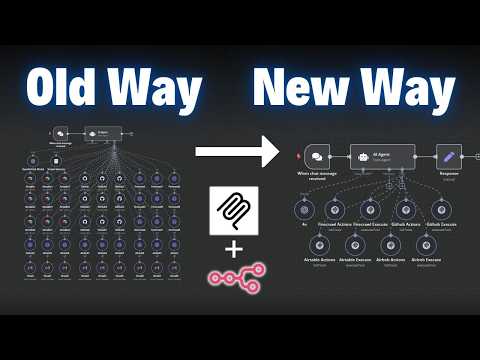 16 minutes
How MCPs Make Agents Smarter (for non-techies)
Nate Herk | AI Automation. A 16-minute, no-jargon explanation of what an MCP server is, how clients like Claude and n8n use them, and what you actually do differently once you have one. Lines up almost exactly with the article's "connect Claude or Cursor to your tools" framing.
Intermediate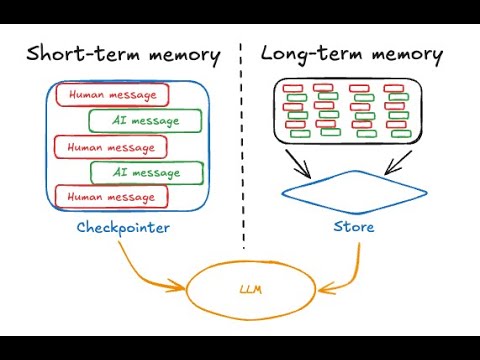 7 minutes
Memory for agents (conceptual video)
LangChain. Short, no-code walkthrough of the short-term-vs-long-term split, the three shapes long-term memory tends to take (instructions, profile, list of objects), and the hot-path-versus-background trade-off for when to write. The article's memory-architecture section assumes exactly this taxonomy.
Advanced 44 minutes
Building Brain-Like Memory for AI | LLM Agent Memory Systems
Adam Lucek. A longer implementation pass through the cognitive-science-inspired categories — episodic, semantic, working, procedural — wired into an agent in code. Worth watching after the LangChain conceptual video if you want a more opinionated mental model and a working example to crib from.
Advanced