

 7 minutes
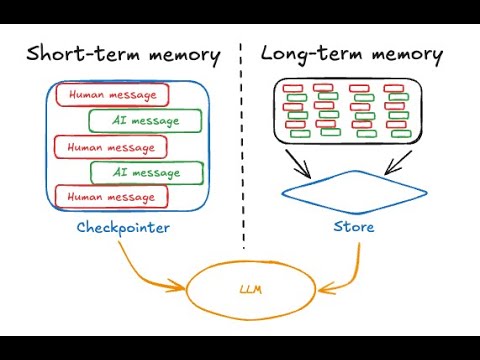
Memory for agents (conceptual video)
Separate short-term and long-term memory decisions and decide when agent memory should be written.
AdvancedAutomations
Chroma. Kelly Hong walking through Chroma's research on 18 models — why needle-in-haystack scores are misleading, how performance degrades with ambiguity and distractors, why even simple string-repetition tasks degrade past 500 tokens. Short, evidence-based, and exactly the case the article needs you to take seriously before getting to the engineering moves.
Model names, pricing and capabilities change quickly. Use this for the decision pattern, then verify current model behavior before adopting it.
Understand how long context can fail under ambiguity and distractors, then design tests around that risk.
None beyond basic LLM vocabulary — it's a short research talk.
Last reviewed: May 18, 2026
Continue through the same learning path with the next curated companion videos.
7 minutesSeparate short-term and long-term memory decisions and decide when agent memory should be written.
 5 minutes
Understand why screenshot-based computer use is powerful, slow, expensive and brittle compared with API-native automation.
 13 minutes
Model prompt injection as untrusted-data mixing and design boundaries around tool use.
Hand-picked external courses that go deeper on this topic.
 DeepLearning.AI
Isa Fulford · Andrew Ng
Ninety minutes to a year's worth of intuition. If you've started writing code that calls an LLM — or you're about to — this is the most efficient course online for closing the gap between "playing with ChatGPT" and "shipping a feature that calls an LLM."
 Microsoft Learn
Microsoft Learn
Prompt engineering, but for the tool most office workers will actually touch first. Microsoft's own four-part prompting framework (goal, context, source, expectation) is a genuinely useful mental model, and unlike the generic ChatGPT prompting courses already in our catalog, this one is grounded entirely in Microsoft 365 Copilot's specific quirks and grounding behavior.