

 18 minutes
Pydantic is all you need: Jason Liu
Learn why schema-first LLM calls need typed objects, validators, retries and explicit handling for malformed or hallucinated fields.
AdvancedAI for Business
Andrej Karpathy. This is the clearest end-to-end explanation on YouTube of what an LLM actually is — pretraining, tokenization, SFT, RLHF, reasoning RL, tool use, hallucinations — at the level of detail an engineer needs to reason about model trade-offs. Watch it once and the "GPT-class vs. open-weights vs. reasoning model" decisions in the article stop feeling like brand choices and start feeling like training-recipe choices.
Model names, pricing and capabilities change quickly. Use this for the decision pattern, then verify current model behavior before adopting it.
Understand the modern LLM stack well enough to reason about tokens, training, tools and failures.
Engineering background helps; no ML prerequisites, but budget for the three-and-a-half-hour runtime.
Last reviewed: May 18, 2026
Continue through the same learning path with the next curated companion videos.
18 minutesLearn why schema-first LLM calls need typed objects, validators, retries and explicit handling for malformed or hallucinated fields.
 77 minutes
Hear how production prompt engineers revise instructions, examples and behavioral constraints under real pressure instead of treating prompts as one-off text.
 55 minutes
Design an eval ladder that catches regressions before prompt or model changes reach users.
Hand-picked external courses that go deeper on this topic.
 Coursera · DeepLearning.AI + AWS
Antje Barth · Shelbee Eigenbrode · Mike Chambers · Chris Fregly
When practitioners ask "what should I take if I'm serious about building with LLMs?", this is the answer. Mathematically honest without being a research paper; AWS-flavoured deployment chapters stay useful even if you'll never touch SageMaker.
 DeepLearning.AI · LlamaIndex
Jerry Liu
Naive RAG (vector search → stuff into prompt) is the version that ships first and disappoints fastest. This short course shows you the upgrade: an agent that plans retrieval, picks tools, compares sources, and answers multi-document questions. Two hours, immediately applicable to a real product.
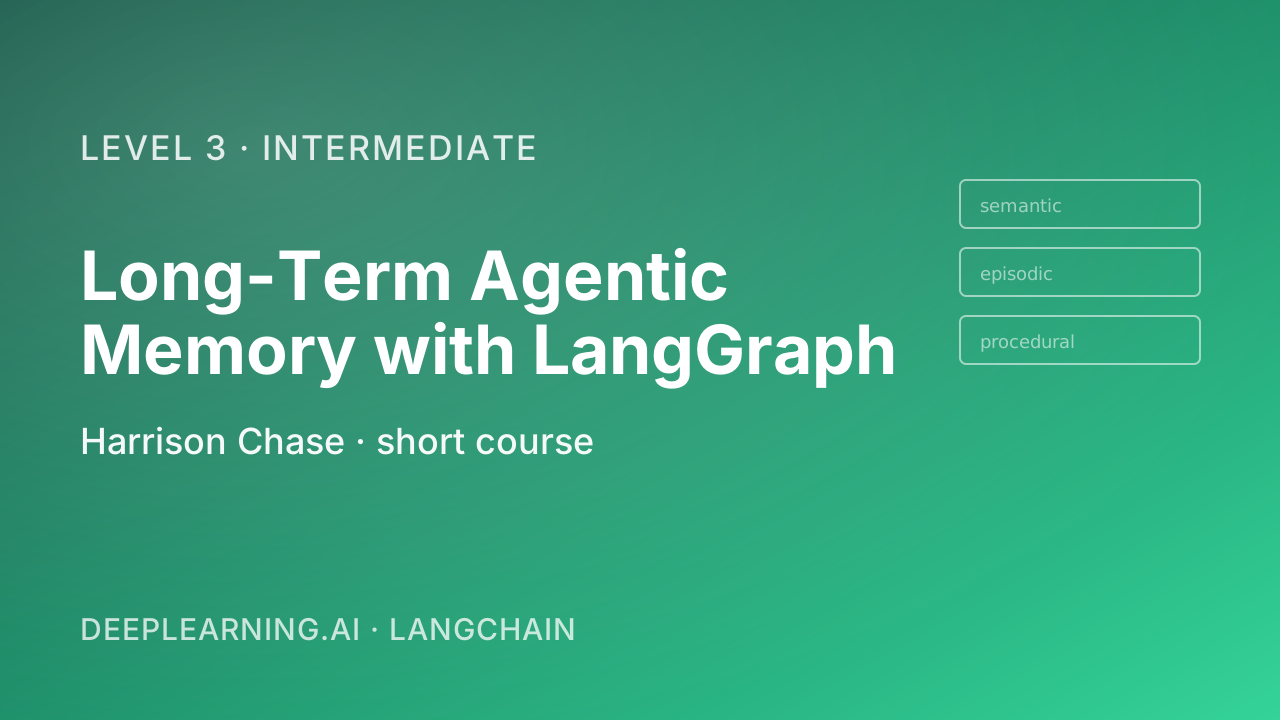 DeepLearning.AI · LangChain
Harrison Chase
The context-window-amnesia problem is what makes most agents feel forgetful and dumb on day two. This course teaches the LangMem patterns that fix it — episodic, procedural, and semantic memory — so an agent remembers user preferences and past interactions across sessions without bloating the prompt.