A small Estonian team can have several working languages without a dedicated translation department.
A small team may sell in English, support customers in Estonian and Russian, read supplier material in Finnish, write website content in English first, and maintain internal notes in whichever language the team used that day. AI can help, but only if the workflow respects terminology, tone, privacy, and review responsibility.
The goal is not “translate everything automatically.” The goal is to move work across languages without losing meaning or creating customer-facing risk.
Treat multilingual AI as an operating workflow, not a translation button. The quality comes from glossaries, source-of-truth rules, review gates, and clear ownership.
The four common workflows
Choose a workflow whose source and review responsibility are clear. Before processing customer or staff text, confirm that the exact tool and account are approved for that data. Preserve the original in its authorized system; do not duplicate it into a shared glossary or public example.
| Workflow | Useful AI role | What must remain explicit |
|---|---|---|
| Support | Draft a reply or internal summary in another language | Customer’s actual request, account permissions and escalation route |
| Sales | Extract a stated requirement and draft a clarification | No inferred budget, buying intent or unapproved commitment |
| Internal knowledge | Retrieve an authorized source across languages | Source version, applicability and permission |
| Public localization | Adapt approved content for a target audience | Source claims, terminology and review of changed examples |
Use the language the reader requests, not one inferred from a name or nationality. A mixed-language message may need a clarification rather than a forced language label.
Design the workflow
Use this sequence.
Step 1: Detect language and intent
The system should identify:
- source language,
- requested output language,
- customer intent,
- urgency,
- sensitive data categories,
- whether human review is required.
Do not assume language from country, email domain, or name. Detect from the actual content and allow the user or operator to override it.
Step 2: Preserve the source
Keep the original text visible and linked. The translated summary is not the source of truth.
For customer support, store:
- original message,
- detected language,
- internal summary language,
- drafted reply language,
- reviewer,
- final reply.
For content localization, store:
- master article version,
- target locale,
- glossary version,
- reviewer,
- publication date.
Step 3: Apply a glossary
Every company has terms that should not drift.
Examples:
- product names,
- service names,
- pricing package names,
- legal entity names,
- support categories,
- technical terms,
- brand voice rules,
- words that should stay in English.
AI localization without a glossary tends to be fluent but inconsistent. The model generates plausible wording; the business needs stable terminology.
Start with the terms that affect the selected workflow. Include the approved term, rejected alternatives, target-language equivalents and a sentence showing the intended meaning. Size the glossary from actual ambiguity, not a target count.
Step 4: Decide review level
Not every multilingual output needs the same review.
| Output type | Review pattern |
|---|---|
| Internal summary | Review effort based on consequence and measured language errors |
| Draft support reply | Human approval before send |
| Routine FAQ answer from approved source | Exception review only after evaluating that language and source scope |
| Legal, billing, security, HR, medical, or financial content | Human owns final decision |
| Public marketing or website copy | Editorial review before publish |
Match review effort to consequence and observed errors. An internal summary about a legal deadline can need more scrutiny than a public product description.
Step 5: Validate the answer
For customer-facing output, check:
- Does it answer the actual question?
- Does it preserve commitments and limits?
- Does it avoid inventing policy, price, or availability?
- Does it use approved terminology?
- Does it keep the right tone for the customer relationship?
- Does it avoid exposing internal notes?
- Does it include links only from approved domains?
For internal knowledge answers, also check:
- source IDs,
- source freshness,
- permission boundary,
- whether the answer should say “I do not know from the available sources.”
Privacy and data boundaries
Multilingual work often hides privacy risk because the team focuses on language quality.
Do not send customer data to tools that are not approved for that data class. Do not paste full contracts, IDs, medical details, payroll data, or private customer threads into consumer tools unless company policy allows it. Do not use a translation workflow that stores customer content longer than needed.
For company workflows, define:
- which AI tools are approved,
- which languages are supported,
- which data classes are allowed,
- where logs are stored,
- how long inputs and outputs are retained,
- who may review outputs,
- how customers can request correction or deletion when relevant.
Translation does not make personal data less personal. A Russian customer message translated into English still carries the same obligations under the GDPR; for Estonian companies the supervisory authority is the Estonian Data Protection Inspectorate.
Example: support reply workflow
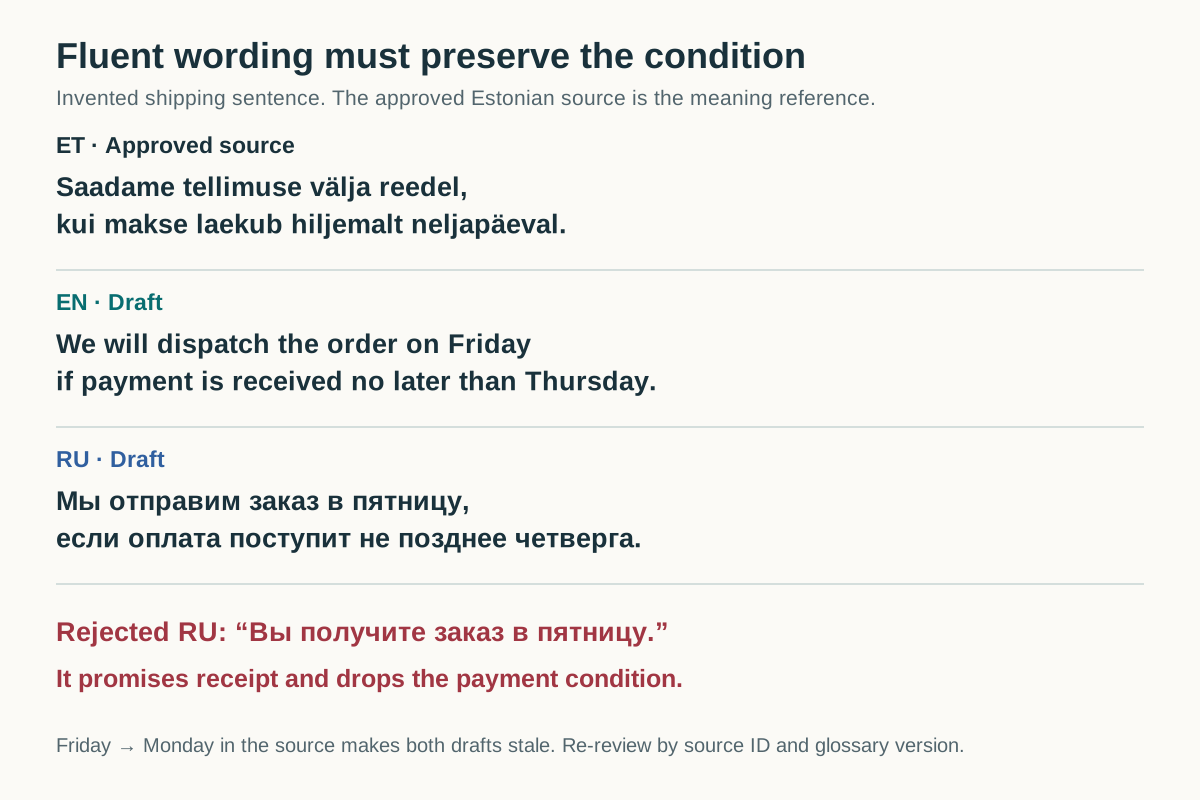
The following sentences are invented to demonstrate a shipping condition. They are not a company’s delivery policy.
Approved Estonian source: “Saadame tellimuse välja reedel, kui makse laekub hiljemalt neljapäeval.”
English draft: “We will dispatch the order on Friday if payment is received no later than Thursday.”
Russian draft: “Мы отправим заказ в пятницу, если оплата поступит не позднее четверга.”
A fluent but wrong Russian variant would be: “Вы получите заказ в пятницу.” It changes dispatch into receipt and drops the payment condition. A reviewer who checks only fluency may approve a promise the source never made.
| Meaning to preserve | Estonian | English | Russian |
|---|---|---|---|
| Dispatch, not delivery | välja saatma | dispatch | отправить |
| Payment must have arrived | makse laekub | payment is received | оплата поступит |
| Inclusive deadline | hiljemalt neljapäeval | no later than Thursday | не позднее четверга |
Keep that glossary row attached to the source version. The reviewer checks the action, condition and deadline directly against the Estonian sentence, then checks whether the target wording is natural. Back-translating through the same model can raise questions but is not independent verification.
If a source revision changes Friday to Monday, mark both translations stale. Search for the source ID, not only the old weekday, because another language may phrase it differently. Publish only the reviewed target version and retain the source/glossary references in the internal record.
For a billing support case, add account authorization and approved troubleshooting evidence before drafting. Extract only the fields needed for the issue; “invoice reference” is not automatically non-sensitive simply because it is short.
Common failure modes
Fluent mistranslation. The output sounds natural but changes the meaning. Review high-consequence material against the source, not just readability.
Terminology drift. Same product or service gets five names across languages. Use a glossary.
Wrong source authority. The model answers from an old translated page instead of the current master. Track source version and last reviewed date.
Tone mismatch. Direct English wording can sound cold or strange in another language. Review customer-facing tone.
Over-localization. Names, product terms, and technical terms are translated when they should remain stable.
Hidden privacy leakage. Internal summaries include customer data that should not be copied into shared channels.
Check each language separately
Include ordinary, ambiguous and high-consequence examples in each supported language. Measure changed commitments, missing negation, terminology errors and inappropriate disclosure separately from readability. A high average across English and Estonian can hide a weak Russian or Finnish path.
Keep a route to a competent reviewer when the source is ambiguous or the team cannot assess the target language. The workflow brief records the source, glossary and checks so a correction can reach every affected translation.