

DGX Spark is a compact NVIDIA GB10 system with a large shared CPU/GPU memory pool. Its useful buying question is specific: can an approved model complete your workload at the required quality, latency and data boundary, with an operator you can fund?
The specifications below come from NVIDIA’s product page and hardware guide, checked on 28 September 2026. They are vendor specifications, not AI Expert measurements. This article provides a procurement decision record; it reports no new hardware benchmark.
What NVIDIA ships (specs, not slogans)
| Planning input | NVIDIA-stated specification | What it does not establish |
|---|---|---|
| Processor | GB10 Grace Blackwell, 20-core Arm CPU | Compatibility with an x86-only dependency |
| Memory | 128 GB LPDDR5x coherent unified system memory | 128 GB available solely for model weights |
| Bandwidth | 273 GB/s memory bandwidth | Application tokens per second |
| Peak compute | Up to 1 PFLOP at FP4 | Sustained serving speed or model quality |
| Storage | 4 TB NVMe in the listed NVIDIA configuration | Space remaining after models, images and backups |
| Networking | 10 GbE and ConnectX-7 listed at 200 Gbps | End-to-end throughput for your topology |
| Software | DGX OS and NVIDIA software paths | A maintained agent application or accepted production service |
CPU, GPU, runtime, model state and operating system share resources. A checkpoint that loads may still fail when context or concurrency grows. NVIDIA markets up-to-200B-parameter local models and currently advertises multi-system configurations up to four Sparks; model size is conditional on precision and software support. It does not mean every checkpoint at that size works, or that linked machines form one coherent memory pool.
For a two-node design, use the current clustering guide and connection runbook. More nodes add communication and recovery requirements. They need a workload justification, not just a larger summed memory number.
Start with one workload and a rejection rule
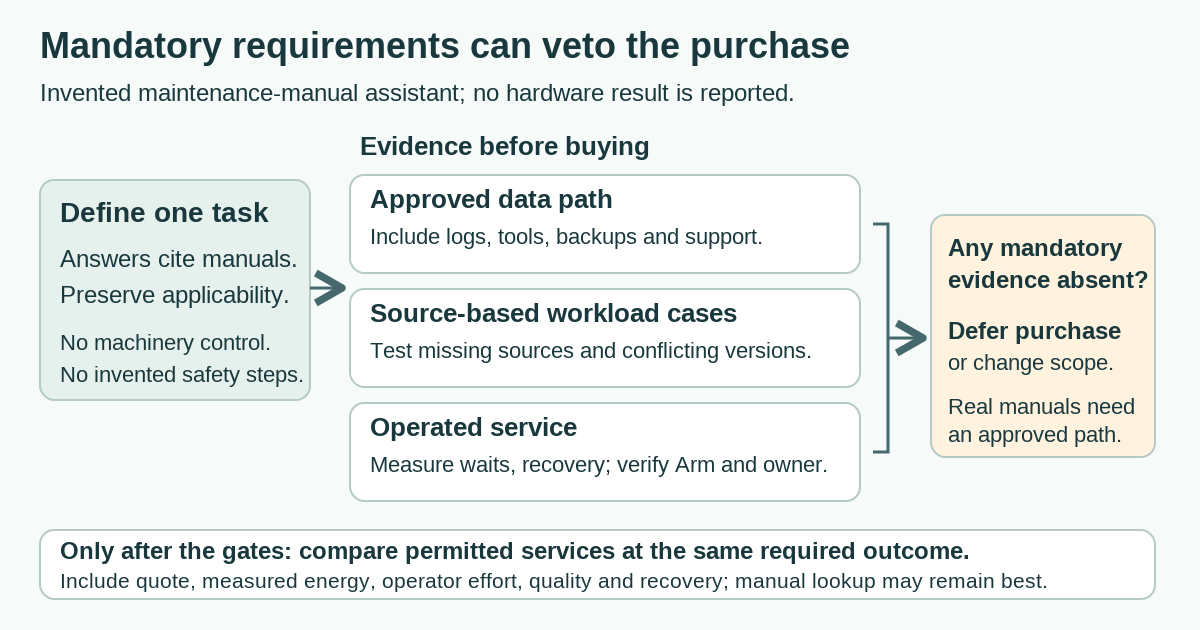
Consider an invented engineering firm evaluating a private maintenance-manual assistant. It must draft answers from approved manuals and name the supporting passages. It cannot issue safety instructions beyond those sources or control machinery. The example below is a proposed decision record, not a customer result.
| Requirement | Evidence needed before buying | Decision if absent |
|---|---|---|
| Restricted manuals remain in approved infrastructure | Complete data-flow map, including logs, tools, backups and support uploads | Do not trial real manuals on that path |
| Answers preserve model/part applicability | Fixed source-based cases, missing-source and conflicting-version cases | Change retrieval/model design or retain manual lookup |
| Interactive service meets the team’s declared wait tolerance | Measured first-token and completion times under expected concurrency | Reject that configuration; a memory-fit demo is insufficient |
| Endpoint survives a restart | Recovery runbook and observed reload time | Limit scope to attended evaluation |
| Arm software path works | Pinned serving image and every required parser/tool dependency verified | Resolve compatibility before procurement approval |
| Someone owns updates and incidents | Named operator, time allocation and replacement plan | Choose an acceptable managed path or keep the existing process |
A failed mandatory requirement cannot be compensated by a good aggregate score. If the restricted-data boundary is mandatory and no suitable operated configuration exists, the answer may be to defer AI for this task.
Who operates it
The business owner defines the task, quality bar and budget. The platform owner handles DGX OS, network access, backups, disk capacity and patch windows. The model owner maintains the serving image, model revision, evaluation set and rollback. The application owner controls tools, recipients and exception handling. One person can hold several roles, but the workload must fit that person’s available time.
Consult the release notes before changing drivers or DGX OS, and rerun the accepted workload after the update. Plan physical custody, airflow, power and interruption recovery. A desktop form factor does not eliminate infrastructure duties.
Local inference covers one data-processing stage. A browser tool, external messaging channel, crash uploader or cloud log exporter can still transmit private content. Map those paths before calling the system private. Credentials and production data should not be inherited through a broad home-directory mount.
Compare the whole service
Compare Spark, an existing workstation, a managed endpoint and a non-AI process against the same required outcome. Do not assume a local model wins latency because the network is nearby; queueing and generation time can dominate. Do not assume the newest hosted model is better for this task without the same evaluation.
| Cost or constraint | Record |
|---|---|
| Acquisition | Dated supplier quote, tax, shipping, warranty and required accessories |
| Operation | Measured power at the intended duty cycle, staffing and update time |
| Storage/recovery | Model copies, backups, restore test and replacement lead time |
| Quality | Accepted outputs, corrections and failures under the same task rubric |
| Capacity | Arrival pattern, concurrent work, wait time and overload behavior |
| Exit | Exportable data/configuration and a permitted fallback |
Use the hosting break-even method for arithmetic. A data restriction is a veto on a forbidden provider, not proof that any local purchase is good value. Redaction does not automatically authorize a cloud fallback. If the local service fails, use an explicitly permitted alternative or stop and return to the manual process.
What “local agents” actually need beyond the SoC
The maintenance-manual example first needs a source-controlled retrieval path and a model endpoint. It may not need an autonomous agent at all. Add tools only for a specific accepted capability.
A minimal operated service needs authenticated access on a private boundary, current source permissions, a fixed output contract, minimized telemetry and an external stop control. Tool calls require service-side authorization regardless of whether the model runs locally. Private deployment patterns covers the data path; local inference measurement covers hardware acceptance.
Procurement and rollout checklist
Use the Spark workload decision record to complete one evaluation:
- Write the task, exclusions and mandatory requirements before selecting hardware.
- Confirm current NVIDIA specifications and get a dated quote for the actual configuration.
- Reproduce an appropriate NVIDIA playbook using pinned model and image revisions in a clean evaluation environment.
- Run the declared quality, capacity, failure and data-boundary tests. Record unsuccessful cases as well as successful output.
- Compare total service cost with the approved alternatives, including staff effort and manual fallback.
- Approve only the tested scope. Keep untested clustering, agent tools and external channels as separate changes.
The purchase decision becomes reviewable when it says which workload passed, on what configuration, at what cost, with what remaining limits. A product specification alone cannot supply that evidence.