


DGX Spark’s headline for builders is not “a GPU under the monitor.” It is 128 GB of coherent unified system memory on a Grace Blackwell GB10, plus a NVIDIA-supported software path (DGX OS, containers, clustering). That combination changes what you can host locally; and it does not erase memory math, serving bugs, or cloud economics.
This is the operational companion to what DGX Spark is. Specs and messaging are anchored to NVIDIA’s product page and release notes (documentation checked 2026-09-28).
Code evidence rule: the serving-stack sketch and commands in this guide are Conceptual pseudocode or operational checklists unless a section explicitly says Runnable example. The runnable fixture below computes from synthetic records; it is not a DGX Spark benchmark or a deployment recipe.
Local inference still consumes substantial power and heat. Size circuits and cooling for continuous load, not idle demo mode. Do not expose OpenAI-compatible ports to the public internet without auth, TLS, and network policy.
Unified memory: what “128 GB coherent” means in practice
On a classic discrete GPU box you plan around GPU VRAM for weights and KV cache, and host RAM for everything else, with transfers across the PCIe boundary.
On Spark, NVIDIA’s architecture presents coherent unified system memory: CPU and GPU share one large pool (128 GB LPDDR5x per NVIDIA). For serving design that means:
- Large model weights can reside in the same pool the runtime uses for activations and KV cache.
- You still have a hard ceiling: weights + KV + framework overhead + OS + other services must fit.
- Bandwidth and latency characteristics differ from HBM-heavy datacenter GPUs. NVIDIA lists memory bandwidth on the product page; treat it as a hardware limit, not a tok/s promise.
Rough memory budget (illustrative, not a guarantee)
Use this as a planning sketch. Exact footprints depend on architecture, quantization, and serving engine.
| Consumer | What it eats |
|---|---|
| Model weights | Dominant term; FP4/FP8/INT4 change the curve sharply |
| KV cache | Grows with context length × concurrent sequences |
| Runtime / CUDA graphs / framework | Non-trivial fixed overhead |
| OS + Docker + agents + monitoring | Easy to underestimate on a “dedicated” box |
| Headroom | Leave margin for spikes and upgrades |
Budget from measured peak concurrent contexts, not a single chat. KV-cache growth is one OOM risk; reproduce it with a load test rather than treating a hypothetical two-session failure as history.
Reading NVIDIA’s ~200B single-node claim
NVIDIA markets DGX Spark for AI models up to ~200 billion parameters on one desktop unit with the large unified memory. Read that as:
- Vendor capability messaging, not a measured SLA for every open checkpoint.
- Implicitly tied to efficient precision (NVIDIA highlights FP4-class peak performance up to 1 PFLOP FP4) and a supported serving path.
- Independent of whether your preferred model, tokenizer, tool-calling template, and eval suite behave well at that size.
What the claim does not say:
- Full-precision 200B at long context with high concurrency.
- Parity with frontier hosted models on hard tasks.
- A specific tokens/s number you can put in a customer contract.
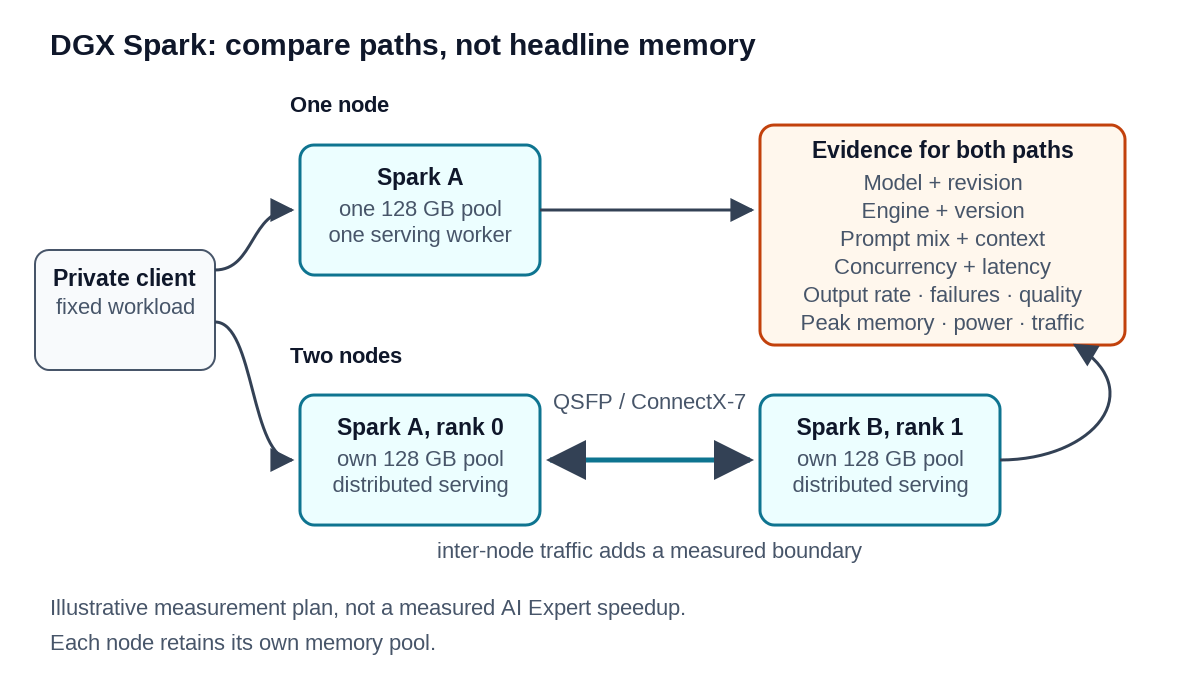
For larger models or tensor-parallel serving, NVIDIA documents multi-node scaling via ConnectX-7. See clustering docs and connect two Sparks. Each appliance retains its own memory pool; the serving engine coordinates work across nodes over the fabric. A two-node setup may make a model fit or change throughput, but it adds a link, distributed runtime and another failure point. Community recipes (for example tensor-parallel vLLM over RoCE) are recipe-specific; treat their tok/s and max context as reports to re-measure, not universal guarantees.
Documented serving-stack candidates
A useful mental model:
DGX OS (Ubuntu-based NVIDIA stack)
  → NVIDIA drivers / container runtime
    → Serving container (vLLM, TensorRT-LLM, NIM, or other)
      → OpenAI-compatible HTTP (or gRPC)
        → Agents / n8n / apps on LAN
DGX OS and containers
DGX Spark runs DGX OS. Plan updates, reboot windows, and Docker (or equivalent) permissions the same way you would for any inference host. NVIDIA’s playbooks assume a current DGX OS install and working nvidia-smi / container GPU access before you chase model bugs.
Serving options (choose by criteria, not fashion)
| Stack | Typical reason to pick it | Watch-outs |
|---|---|---|
| vLLM | OpenAI-compatible serving, broad open-model coverage, multi-node recipes | Version + quantization compatibility; tune max seqs/KV |
| TensorRT-LLM (TRT-LLM) | NVIDIA-optimized engines for supported models | Engine build cost; narrower “best path” per model |
| NVIDIA NIM / NGC paths | When you want a NVIDIA-packaged microservice for a listed model | Model catalog and license terms; not every HF checkpoint |
| llama.cpp / Ollama-class | Simple local UX for smaller or quantized models | May not be the path for the largest Spark-class workloads |
Playbooks in NVIDIA dgx-spark-playbooks cover vLLM, TRT-LLM, Ollama, and related paths. Start evaluation from a current vendor-documented playbook, pin every artifact, and customize only after reproducing a baseline on the device.
Agent-facing endpoint
Clients such as n8n and Hermes can use an OpenAI-compatible endpoint, but the base URL and request contract must match the selected client. Check chat completions, streaming, tool-call parsing and context limits independently; a successful /v1/models response does not establish compatibility. Preserve the accepted contract when swapping engines. Log model id, quantization, and server version with every eval run so “it got worse” is diagnosable.
Measurement protocol (minimum)
Before you call a local model “production”:
- Start with an evaluation set of 20–50 prompts that represent the real job (not toy chat), then expand it as you discover failure classes; this is a smoke-test range, not a statistical guarantee.
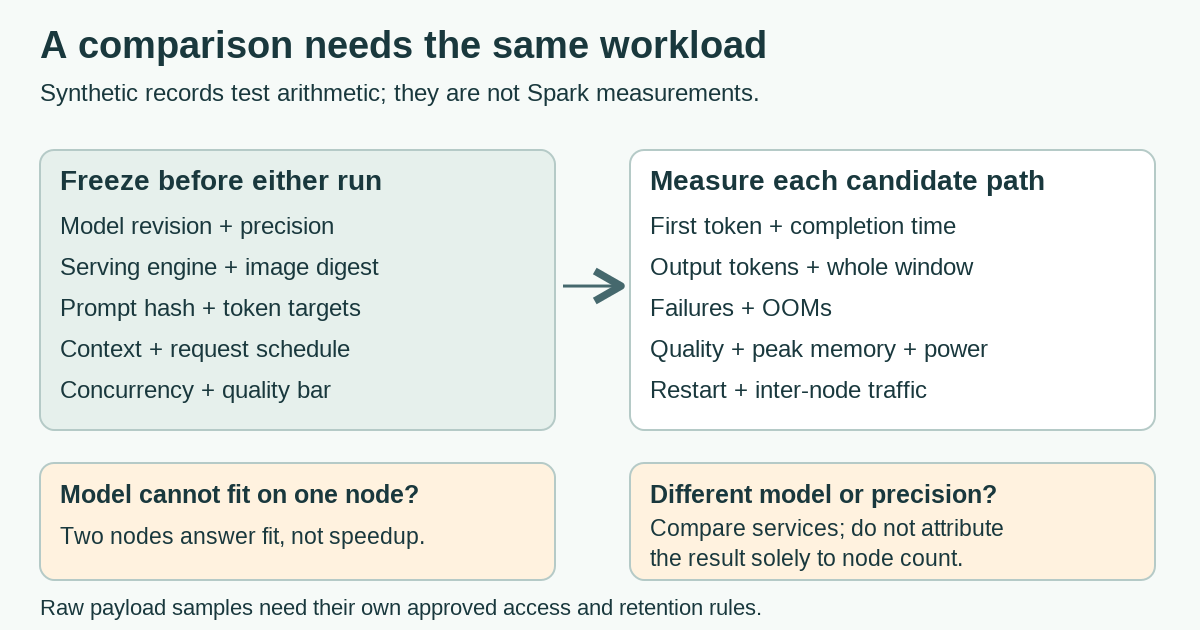
- Freeze the comparison: prompt-set hash, model and revision, precision, serving-engine version and image digest, input/output token targets, context limit, request schedule and concurrency. Record DGX OS/driver versions, node count, network path and ambient load separately. If a model cannot fit on one node, say that the two-node run answers a fit question, not a same-model speedup question.
- Collect per-request time to first token, end-to-end latency, output tokens, failures, and OOMs; record the whole measurement window to calculate aggregate output tokens per second. Capture peak memory, power and inter-node traffic with named tools and versions. Report enough raw observations for the chosen tail metric; a few example requests cannot support a p95 or capacity claim.
- Score quality with a human rubric or automated checks you trust for that task, and report disagreements by task slice. Compare one versus two nodes only at the same quality bar and supported context/concurrency.
- Re-run the same protocol after every engine or OS upgrade. Keep exact commands, versions, result checksums and approved minimal per-request measurements. Store any necessary raw prompt or response sample separately with access and retention controls; a benchmark does not justify unrestricted payload logging. NVIDIA’s performance guide separates offline engine tests from online serving and includes dual-node link measurements; use the current vendor recipe as a starting point, not as your result.
Without that loop, Spark becomes folklore: “it felt fast last Tuesday.”
Runnable example: check a comparison record
Use the DGX Spark workload decision record to record the real configuration, requirements and observations alongside this synthetic calculation.
Evidence label: Runnable example. The repository includes a dependency-free Node.js measurement summarizer, a synthetic one-node/two-node fixture, and the complete expected output. The dependency-free fixture was rerun with Node.js 26.8.2 on 28 September 2026 and matched the checked-in expected output. This validates the synthetic calculation only. From the repository root:
node public/downloads/articles/examples/dgx-spark-measurement.mjs
The script rejects mismatched model, revision, precision, engine, workload or concurrency fields before summarizing success, failure, output tokens, measurement-window throughput and the raw successful latencies. The fixture prints "comparableWorkload": true and "hardwareClaim": false. Its illustrative 12.6 and 19.1 output tokens/s are not measurements from a Spark, and three requests per path cannot establish tail latency, capacity, quality or a real two-node advantage. The separate memory pools and fabric also require measurements that this script does not make.
Failure modes you should design for
| Failure | Symptom | Mitigation |
|---|---|---|
| Weight / KV OOM | Process kill, CUDA OOM, hanging workers | Lower context, concurrency, or precision; split across nodes |
| Thermal / power throttle | Latency cliffs under sustained load | Measure under load; check airflow and circuit |
| Stale container / driver skew | Mysterious crashes after OS update | Pin versions; smoke-test after every update |
| Disk full (model cache) | Pull failures, corrupt layers | Size NVMe for models + logs; prune caches |
| Single-node outage | Agents fail open or silent | Health checks; explicitly permitted fallback or stop/manual route |
| Unauthenticated API | Anyone on the LAN scrapes your private model | Bind to private interface; auth; network ACL |
| Quantization quality cliff | Fluent nonsense on hard tasks | Task-specific eval set before go-live |
| Agent tool abuse | Local model + shell ≠ safe | Sandbox (see NemoClaw); allowlists |
Local does not mean logged nowhere. Decide retention for prompts, tool traces, and retrieved documents. Disk encryption and access control matter as much as “no cloud API.”
Decide from one comparison record
Use the same workload and quality bar for a Spark configuration and an acceptable managed alternative. Data access is a gate before cost comparison. Neither local network proximity nor model parameter count establishes useful latency or output quality.
An illustrative engineering-manual trial might record: source version hash, required applicability questions, model/image revisions, context/concurrency, per-request results, restart recovery and total review effort. If one-node serving cannot fit that model, a two-node run can answer whether it fits; it cannot establish a speedup over an unexecuted one-node baseline. If two configurations use different models or precision, report a service comparison rather than attributing the difference solely to node count.
| Observed result | Decision it supports |
|---|---|
| Loads, but fails expected concurrent contexts | Reduce accepted workload or reject configuration; do not promise capacity |
| Fast responses, but wrong manual revision | Fix source/permission path before optimizing speed |
| Correct answers, but recovery exceeds allowed outage | Add an operated recovery path or keep attended scope |
| Meets requirements at lower total cost | Consider that configuration, with update/retest owner |
| Required cloud path is forbidden | Exclude it; compare allowed local/managed or manual alternatives |
These are decision rules, not reported hardware outcomes. Cost should use a dated quote, measured energy at the intended duty cycle, operator time and quality-equivalent demand. PSU rating and chip TDP are not wall-energy measurements. The hosting cost guide supplies a worked arithmetic method.
A cloud fallback is a separate data-processing decision. Redacting a request does not automatically make it permitted. If no approved alternative exists, stop, queue within the allowed retention boundary, or return to the manual process.
Builder checklist (single node)
Record the DGX OS/driver, serving image digest, model revision and request contract. Verify GPU access and one authenticated private endpoint. Run the fixed quality and load set, including missing sources, long contexts, concurrent requests, restart and overload. Save minimized measurements and the exact comparison configuration.
Only connect an agent after the accepted endpoint contract, access policy and failure behavior are known. A new channel, tool or larger context is a new acceptance scope. Keep the synthetic comparison fixture above as a calculation example; replace its invented inputs with separately captured observations before making a hardware claim.