

AI Myths & Mental Models
Understand what AI is doing, where it fails, and which common myths waste time.
26 stories (12 articles · 14 videos)
Start here
A few good first pieces before you browse the full feed.
 6 min read
What AI actually is (and isn't): a no-hype primer
AI in 2026 means one specific thing for most people — and it is not what the movies told you. A plain-English explanation of what is really going on, what it does well, and what it does not.
New to AI 6 min read
How AI generates answers: the mental model that makes prompting click
AI does not think the way you do. It generates likely continuations from context. A plain-English mental model that, once it clicks, makes every prompting tip in the world easier to understand.
New to AI 7 min read
The ten AI myths holding you back
The persistent beliefs about AI that keep otherwise sharp adults from even trying it. Each one addressed honestly — with what's true, what's exaggerated, and what to do about it.
New to AIMore in this topic
 7 min read
Why AI explanations feel like learning—and often aren't
A fluent explanation can make a subject feel familiar before you can actually use it. These three tests reveal whether AI helped you learn or merely helped you follow along.
New to AI 69 minutes
The Agent Landscape - Lessons Learned Putting Agents Into Production
MLOps.community. Prosus's VP of AI and an AI engineer report what actually broke when they deployed agents across the group's portfolio companies: prompt-injection pen-testing before launch, an unsafe write when a Jira agent choked on human shorthand, stale context handled by making agents surface their assumptions, and fallback design that merged or killed agents once they added cognitive load. It reads like the article's failure-mode register replayed as a live postmortem.
Advanced 10 min read
Production AI failure modes: what breaks after the demo
Build a failure-mode register for hallucination, stale context, prompt injection, unsafe tool use, schema drift, weak fallback, and observability gaps.
Advanced 6 min read
AI vs Google: when to search, when to ask
Search and AI assistants are not interchangeable. A practical guide to which tool fits which question — with side-by-side examples and the cases where you should use both.
New to AI 8 min read
The anatomy of a prompt: role, context, task, constraints, format
A five-part template for making important prompts clearer, easier to review, and easier to improve. With worked examples, common mistakes, and a practical order.
Beginner 10 min read
Chain-of-thought, self-critique, tree-of-thoughts — when to use each
Three reasoning techniques that can improve AI output on hard problems — and the cost-benefit tradeoffs of using them. With concrete prompts, side-by-side comparisons, and the gotchas modern reasoning models introduce.
Intermediate 11 min read
Chunking, reranking, and hybrid search: make RAG actually work
Most RAG implementations work poorly because they get three things wrong. A practical guide to chunking documents, reranking results, and combining keyword with semantic search — without becoming a search engineer.
Intermediate 10 min read
Choosing and prompting reasoning models
Reasoning settings change quality, latency, cost, and sometimes prompting behavior. A practical guide to choosing them by evaluation rather than folklore.
Intermediate 7 min read
Picking the right model for the job: a 2026 decision cheat sheet
Which model to reach for, by task type. GPT, Claude, Gemini, reasoning variants, and open-weights options, with decision rules and mid-2026 examples rather than a timeless ranking.
Beginner 6 min read
Why AI gives confident wrong answers: a beginner's guide to hallucinations
AI does not lie the way a person does. It can generate fluent false specifics because plausibility and verification are different jobs. Here is what is going on, why it happens, and how to avoid being burned.
New to AI 10 minutes
Learn 80% of Perplexity in under 10 minutes!
Jeff Su. Jeff opens with the spectrum the article hinges on — ChatGPT and Gemini at the "creative" end, Perplexity and Google Search at the "accurate, real-time, sourced" end — and then shows you the third option in action. The Olympics-medals comparison in the middle is the cleanest "this is when you ask a chatbot, this is when you Google" demo we've seen. After watching, you'll have a third tool in your search routine and a working rule for picking between the three.
New to AI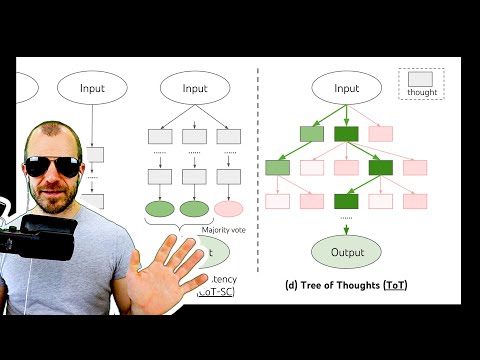 29 minutes
Tree of Thoughts: Deliberate Problem Solving with Large Language Models (Full Paper Review)
Yannic Kilcher. Yannic walks through the original Tree-of-Thoughts paper from Princeton/DeepMind — the generate-score-prune-backtrack loop, why it lifts Game of 24 accuracy from 4% to 74%, and where the technique stops being worth its 10× token cost. Useful precisely because it forces you to see ToT as a search algorithm, not a magic prompt prefix.
Intermediate 25 minutes
Prompting 101
Anthropic. Two members of Anthropic's Applied AI team build up a real-world prompt live, layering in role, structured sections and explicit thinking steps. It's the most credible "how to use chain-of-thought without ritualizing it" demo on YouTube, and it makes the article's "stop pasting Let's think step by step into everything" point concrete.
Intermediate 131 minutes
How I use LLMs
Andrej Karpathy. A follow-up where Karpathy actually sits in front of ChatGPT, Claude, Gemini and Perplexity and uses them like a power user. Watch this after the article and his "Intro" — you'll see the mental model put into practice in real time, including the small choices (which model, which mode, when to paste vs upload) that separate frustrated beginners from people who get useful answers on the first try.
New to AI 60 minutes
[1hr Talk] Intro to Large Language Models
Andrej Karpathy. A founding OpenAI engineer giving the cleanest hour-long explanation of what an LLM actually is, in plain English. The "psychology of an LLM" section is exactly the mental model the article is trying to install — why these models hallucinate, why they're good at vibes and bad at counting, why prompting is closer to coaching than coding.
New to AI 3 minutes
Building OpenAI o1
OpenAI. This three-minute first-party video records how the OpenAI team presented o1 at launch. It is useful for understanding the category's history, but it does not establish how current models work internally or which prompting pattern will perform best on a different provider or task.
Intermediate 28 minutes
o1 - What is Going On? Why o1 is a 3rd Paradigm of Model + 10 Things You Might Not Know
AI Explained. The video offers an independent explanation of the early o1 framing and its prompting implications. It is useful historical context, but its claims about o1 should not be extended automatically to later OpenAI models, R1, Claude thinking modes or other providers.
Intermediate 34 minutes
"Generative AI" is not what you think it is
Acerola. A developer-essayist works through the "AI is just slop / AI is magical / AI is theft" trio of myths with patience and code on the screen. If the article's myth #4 or #7 ("it's just plagiarism," "it's just plagiarism but for art") nagged at you, this is the video that earns the right to disagree with you.
New to AI 12 minutes
What We Get Wrong About AI (feat. former Google CEO)
Cleo Abram. Cleo Abram walks through both the "it will kill us all" and "more profound than fire" extremes, asks Eric Schmidt the awkward questions, and lands on a sober middle. The framing — "we're living inside a trolley problem" — is exactly the spirit of the article: neither dismiss the technology nor catastrophise it, just understand what it actually is.
New to AI 36 minutes
Andrew Ng: Opportunities in AI - 2023
Stanford Online. Andrew Ng, one of the people who actually built the field, talking plainly about what AI is good at, what it isn't, and where the realistic opportunities sit. A useful counterweight to social-media takes — same calm, no-hype tone as the article, just with more depth on the "where is this actually going" question.
New to AI 8 minutes
Large Language Models explained briefly
3Blue1Brown. The cleanest eight-minute mental model of an LLM on YouTube. Grant Sanderson walks through "next-word prediction," parameters, training, and reinforcement learning from human feedback without ever drifting into hype. Watch it right after the article and the phrase "AI is just autocomplete on steroids" stops being a slogan and starts being a useful shorthand.
New to AI 10 minutes
Why Large Language Models Hallucinate
IBM Technology. Martin Keen sorts hallucinations into four named buckets — sentence contradictions, prompt contradictions, factual errors, nonsense — and walks through each on a lightboard. After the article gives you the why, this video gives you a vocabulary for spotting the type of mistake in the wild so you can decide how much to trust a given answer.
New to AI 36 minutes
ChatGPT with Rob Miles - Computerphile
Computerphile. A long, calm sit-down with AI-safety researcher Rob Miles on why a model that's trained to predict plausible text will always, structurally, sometimes invent facts. Recorded in early 2023, but the underlying mechanism it explains hasn't changed and the framing is still the cleanest way to internalise "it's a fluency engine, not a truth engine."
New to AI