Choose an assistant by testing a task you can judge. Begin with two products you can access through an appropriate account, then compare the work needed to turn their answers into something usable. You do not need a universal winner.
Build a shortlist from your situation
For workplace use, first check which exact accounts and data categories are approved. A familiar brand name does not establish the permissions or terms of a personal account. For private learning, start with fictional or public material and avoid connecting an inbox or drive just to try the interface.
| Your starting point | Candidate to investigate | Question to answer before connecting anything |
|---|---|---|
| An approved Google workspace | Gemini in the eligible account | Which services and sources are accessible under these settings? |
| An approved Microsoft workplace account | The Copilot product included or offered there | Which entitlement and tenant controls apply? |
| A standalone writing or analysis task | ChatGPT and Claude, or another eligible pair | Which preserves the supplied facts with less correction? |
| A current factual question | A search-enabled assistant or ordinary search | Can you open a primary source that supports the actual claim? |
The table selects candidates, not rankings. Google’s Workspace connection guidance, Microsoft’s Copilot product information, ChatGPT’s plan page and Claude’s plan page are starting points for account-specific checks. They were accessed on 28 September 2026. Confirm the offer in your own account before paying or granting access.
Use an answer key you can inspect
Try this fictional task in a fresh conversation in each product:
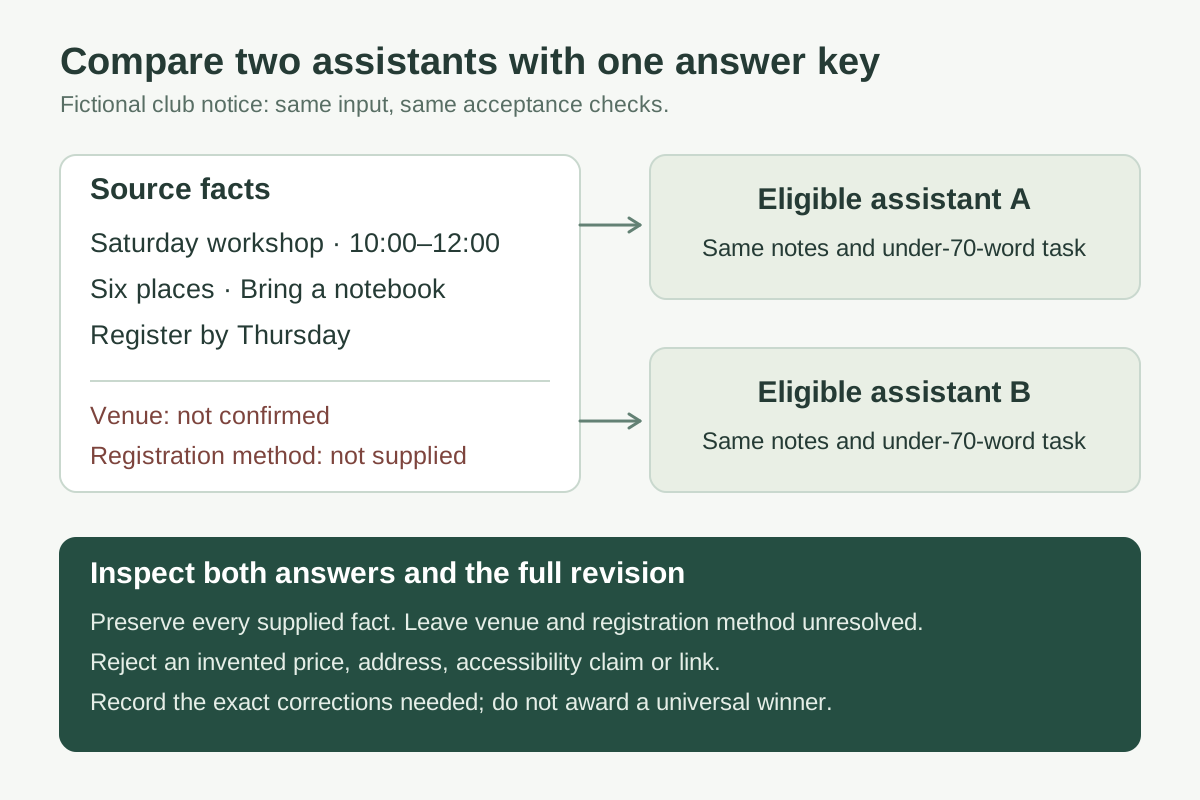
Turn these notes into a public club announcement under 70 words. Saturday workshop, 10:00 to 12:00; six places; bring a notebook; venue not yet confirmed. Ask readers to register by Thursday. Do not invent a price, address, accessibility claim or registration link. Clearly mark missing information.
An AI-generated teaching example, checked against the notes, is:
Join our Saturday workshop from 10:00 to 12:00. Six places are available. Please bring a notebook and register by Thursday. Venue: to be confirmed. Registration method: to be added before publication.
This is an authored comparison target, not output recorded from the named products. A real result that invents a venue fails even if its prose is more appealing. A result that asks “Where is it?” may be useful, but a question that repeats an already supplied time adds work. Asking questions is not intrinsically a sign of quality.
Compare correction effort
Use the comparison card. Check omitted facts, invented facts, format and tone before judging the interface. Record the specific correction you made, rather than awarding a vague intelligence score.
Give both candidates the same correction, such as “Keep the missing-venue notice; remove the enthusiastic adjectives.” Inspect the complete revision. Did either lose the registration deadline while improving the tone?
A small exercise tells you about this task under these conditions. It does not establish the best model for every kind of work. If documents or current sources are central to your use, add a short permitted-source task with an answer you can verify.
Make a reversible choice
Choose the assistant that meets the data boundary and produces acceptable work with manageable corrections. Keep the original document and final result outside the chat so changing tools does not require rebuilding your work.
Review the choice when the task, product or terms change. Consult the provider’s data guidance, including OpenAI’s data controls, before moving from fictional practice to real material. If neither assistant adds value after checking and editing, keep the manual method. That is a valid test result.