Asking a model for a complete rewrite can replace the author’s structure and voice with generic wording. A more controlled pattern is to use it as a fallible second reader and request one kind of feedback at a time.
Editing is not fact-neutral: a model can still change meaning, introduce an error, flatten a distinctive voice or mishandle sensitive text. The control is three small passes, a quoted explanation for each proposed change, and a human decision at the end. OpenAI’s current prompting guidance recommends clear, specific instructions and iterative refinement (checked 2026-09-21); it does not guarantee editing quality.
Before pasting, check whether the draft contains personal data, confidential work, client information, unpublished results or another person’s words. Use a fictional or deliberately non-sensitive excerpt unless the exact tool, account and workflow are approved for the material. Product data controls do not replace permission or organizational policy; see the current Data Controls FAQ and Temporary Chat guide.
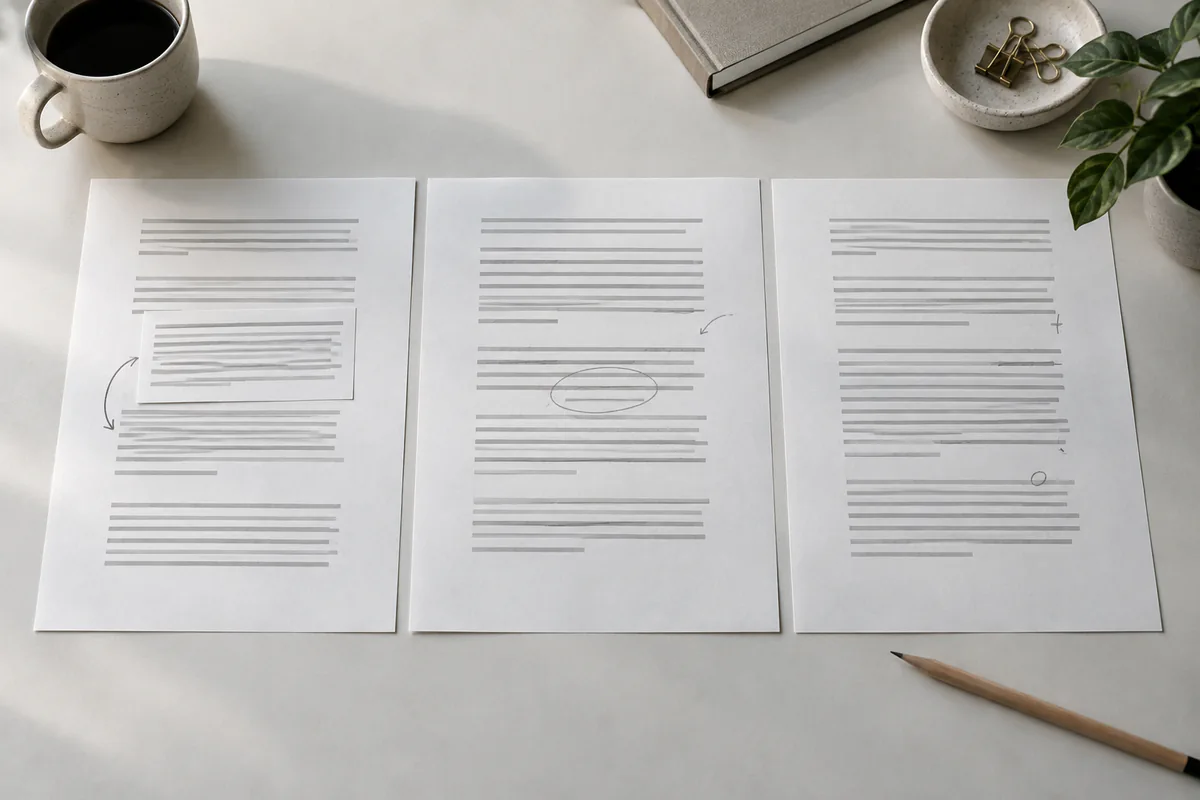
The three-pass model
The mistake people make is asking for “feedback” or “edits” in one big prompt. The model will then rewrite your text in three ways at once: it changes the structure, swaps in different vocabulary, and “smooths” the rhythm. The result is technically better and not yours anymore.
The fix is to ask for one thing per pass.
Pass 1: Clarity. Is the meaning clear? Are any sentences doing two things? Is anything ambiguous?
Pass 2: Tone. Does the voice match what I want? Is it too formal, too breezy, too apologetic?
Pass 3: Grammar. Final cleanup — typos, awkward constructions, real grammar errors.
Each pass is short and targeted, and at the end you have improved the draft without losing yourself in it.
Pass 1: Clarity
The clarity pass is the most underused. Most “AI feedback” you get jumps straight to wording, but the highest-leverage edits are about meaning. A prompt that works:
Read this draft carefully. Do not rewrite anything yet. Tell me:
- The three sentences that are working hardest — the ones I should not change.
- Any sentence that is trying to do more than one thing and should be split.
- Anything ambiguous — where a reader might walk away with a different meaning than I intended.
- Anywhere the structure could be reordered for better flow.
Be specific. Quote the original line each time.
Paste an approved excerpt and inspect the response. Accept nothing automatically. Decide which structural or meaning-level observations are valid, make those changes yourself, and then move to pass 2.
The line-quotation requirement makes each observation auditable against the source. A vague statement such as “the structure could be tightened” does not identify a change you can verify.
Pass 2: Tone
Once meaning is sound, the next pass is voice. Here you have to be a bit specific about whose voice you want — yours, your company’s, or some target reader’s. A reliable prompt:
Now read it again with one question in mind: does this sound like me?
About me: I am [your role, your industry, your default style — direct, warm, dry, etc.]. The audience for this piece is [who]. I want them to come away feeling [what].
Identify any sentence that sounds off-key for that tone. Quote the line, say what is off about it, and suggest one or two alternatives.
Do not rewrite the whole thing. Surgical edits only.
The “surgical edits only” line bounds the request. A model can still return a full rewrite or alter the voice, so reject output that exceeds the requested scope.
After this pass, accept the edits that genuinely match your voice and reject the ones that flatten it. Some suggestions will improve consistency; others will push the draft toward generic wording. Accept only changes that preserve the intended meaning and voice.
Pass 3: Grammar and polish
Last pass, smallest pass. Once meaning and tone are good, you can hand the polish over with confidence.
Final pass. Edit only for: typos, real grammatical errors, awkward constructions, and accidental repetition. Do not change phrasing for style. Do not rewrite for clarity — that was the previous pass. Quote and explain each change.
Treat this pass as a list of proposed edits, not a final draft you can send automatically. Recheck facts, names, numbers, quotations, links and commitments in the full source after applying any suggestion. If you want more aggressive polish, run a separate prompt asking for “the lightest possible edit pass, with no tone or structure changes,” then review the diff again.
A complete worked example
To make this concrete, here is an illustrative draft for a fictional company blog:
We’re really excited to share that we’ve just launched our brand new dashboard, which we think you’ll love. Our team has been working incredibly hard on this for the past several months, and we believe it represents a significant step forward for our product. There are several new features that we know you’ll appreciate, and we’d love for you to try them out and let us know what you think.
In an illustrative clarity review, a reviewer could flag that the paragraph mentions a launch, hard work, and several features without naming any feature. One possible revision is a direct opening followed by concrete changes:
You rewrite to:
We just shipped a new dashboard. The three changes most users will notice: a single inbox for all alerts, a redesigned weekly summary, and faster search across all your projects. It’s live for everyone today.
An illustrative tone review could question whether “shipped” fits the intended audience and offer “released” or “launched” as alternatives. The author decides based on the publication’s actual voice.
In this constructed example, the final grammar pass proposes no change. This is an authored demonstration, not recorded model output or evidence that another tool would behave the same way.
The important result is the visible sequence of decisions, not a promised completion time.
Where this falls apart
Three failure modes worth naming.
Trying to edit your way out of a bad first draft. If the structure is wrong or the central idea is missing, no amount of clarity-tone-grammar passes will save it. Sometimes the right move is to scrap the draft and ask the model to “interview me for fifteen minutes about this topic,” paste your answers in, and write a new first draft from scratch.
Letting the model decide on tone. Outputs vary by model, version, settings and context. If you do not define whose voice to preserve, the revision may drift toward generic wording. Anchor the tone in pass 2 and compare the suggested edit with the original.
Skipping the read-through. It is tempting to accept all suggested edits in one click. Don’t. Read each suggestion before applying it. Expect some suggestions to be wrong or out of scope; the author needs enough command of the subject and language to reject them.
A bounded interpretation check
Once a week, pick a non-sensitive piece of writing that did not land as intended. Remove personal or confidential details, then ask: “List several plausible ways a reasonable reader could interpret this differently. Quote the phrase behind each interpretation. Do not infer the reader’s motive.”
Treat the response as hypotheses, not evidence about what the actual reader thought. Compare it with real feedback when available.
The whole workflow, again
Three passes, one job per pass. Clarity, tone, grammar — in that order. Be specific, accept the surgical edits, reject the generic-corporate ones. Don’t ask the model to make your writing better. Ask it to find the parts that are not yet doing what you want, then decide for yourself what to change.
That is the operational difference between using AI as a bounded second reader and delegating authorship: the former preserves a visible human decision at each change; the latter does not.