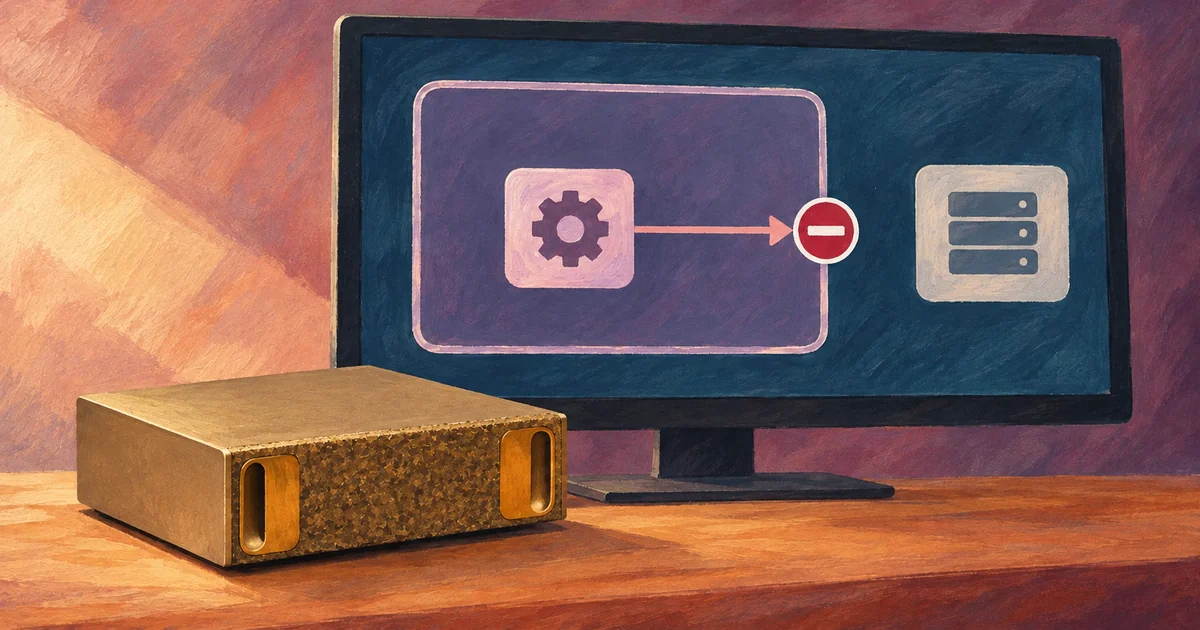

This is a plausible lab architecture after buying a second DGX Spark: local inference for a large model, automation that talks to business systems, and an agent runtime. It is not a supported turnkey stack.
The defensible version is narrower. You are evaluating four layers that must stay separable:
- Fabric: two Sparks linked for distributed inference (NVIDIA clustering docs, connect-two-sparks playbook).
- Experimental model server: a community-built OpenAI-compatible path for DeepSeek-V4-Flash (or the DSpark speculative-decoding variant) across both nodes.
- Deterministic automation: n8n for webhooks, schedules, CRM/email/Slack side effects, validation, and human gates.
- Judgment runtime: Hermes Agent for triage, drafting, investigation, and tool use that needs memory and multi-step reasoning (official API-server documentation, official webhook documentation).
The n8n-to-Hermes composition in this article is an illustrative integration, not a turnkey path documented or supported by either vendor. For a workflow that needs the agent result back in n8n, use Hermes’ bearer-authenticated API server. Hermes’ HMAC webhook adapter is a different event-ingress surface: it triggers an agent and delivers the result to a configured target rather than defining a general synchronous return contract for n8n.
Optional fifth layer: OpenClaw for chat-channel UX (Telegram, Slack, …), optionally launched through NemoClaw and OpenShell when you want sandbox policies. NemoClaw is currently an alpha, early-preview project rather than production-ready software. Neither layer is required for the ticket-drafting workflow below.
Begin this pilot with synthetic inputs and draft-only output. Business actions need separately authorized policy, downstream checks and reconciliation. A successful model run or a favorable confidence score does not authorize an external effect.
What DeepSeek-V4-Flash changes on two Sparks
DeepSeek-V4-Flash is a Mixture-of-Experts model with 284B total parameters and 13B activated, and a 1M-token context window on the official model card. Instruct weights use FP4 for routed experts and FP8 elsewhere. That combination matters on Spark because:
- Activated parameter count stays manageable for decode cost relative to dense models of similar “headline” size.
- Long context is useful for agent workloads such as repository slices, ticket histories, and policy packs, provided you retrieve the right material and still verify claims.
- The DSpark checkpoint is the same model with a speculative-decoding module attached. Its official model-card example uses one four-GPU GB300 node, not two Sparks; the community vLLM report discussed below uses the non-DSpark checkpoint on two GB10 systems.
Treat published tokens/sec and maximum-context results as recipe-specific reports, not guarantees for your cable, driver, container, or concurrency settings. The official model cards do not document a validated dual-Spark deployment; the DSpark example uses one four-GPU GB300 node. As re-checked 2026-09-28, open vLLM issue #40969 reports a hang after the sixth or seventh request on two GB10 systems for one pinned vLLM build with FULL_AND_PIECEWISE CUDA graphs, chunked prefill, Marlin MoE, FP8 KV cache, and TP=2. It is evidence about that configuration, not every deployment. Adopt this path only as a pinned experiment with a rollback model.
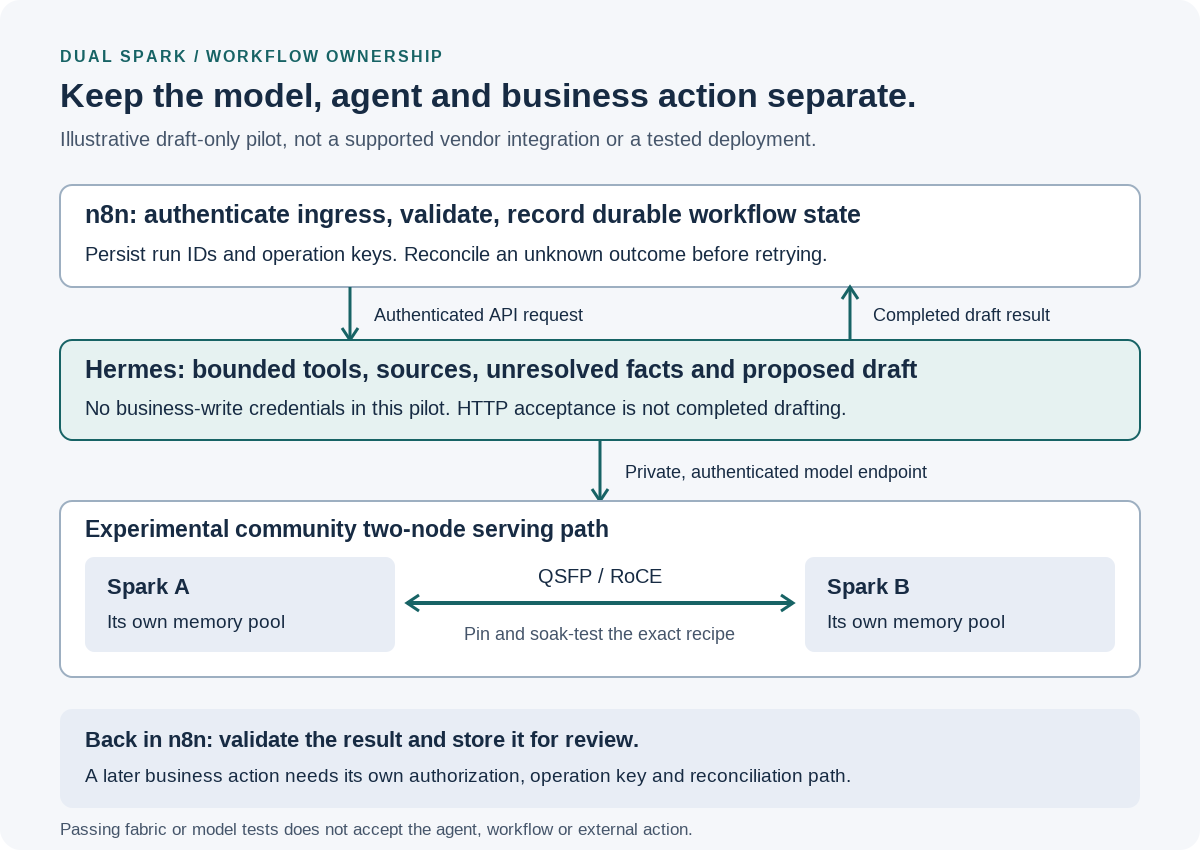
Reference architecture
                    ┌─────────────────────────────┐
   Forms/CRM/Git ──►│ n8n (validate, branch, HITL) │──► Slack / CRM / email
                    └──────────────┬──────────────┘
                                   │ HTTPS + bearer auth
                                   ▼
                    ┌─────────────────────────────┐
                    │ Hermes (memory, tools, draft)│
                    └──────────────┬──────────────┘
                                   │ OpenAI-compatible /v1
                                   ▼
              ┌────────────────────────────────────────┐
              │ Spark A ◄── QSFP / RoCE ──► Spark B    │
              │ experimental community TP=2 model path │
              └────────────────────────────────────────┘
Design rules that keep this from becoming a demo:
| Layer | Owns | Must not own |
|---|---|---|
| n8n | Triggers, schemas, retries, SaaS writes, approvals | Open-ended shell on the LAN |
| Hermes | Classification, drafting, research steps, tool use | Silent production side effects |
| Model server | Tokens in / tokens out | Business credentials |
| OpenClaw (optional) | Human chat channels + allowlists | Unsandboxed host root |
Point Hermes (and n8n AI nodes, if you use them) at the cluster endpoint as a normal OpenAI-compatible base URL. Store credentials outside model context and ordinary logs. Authenticate the private endpoint, restrict callers and use a protected transport; a LAN alone is not an access control.
Bring-up checklist (order matters)
1. Dual-Spark fabric
Follow NVIDIA’s playbook, not folklore:
- Same username on both nodes.
- One QSFP cable between matching ConnectX-7 ports. NVIDIA’s playbook states that full bandwidth is achievable with one cable, and documents no throughput gain from a second cable between the same two systems.
- Dedicated L3 addressing / netplan for the high-speed path; keep 10 GbE or Wi-Fi for management and internet.
- Passwordless SSH between nodes.
- Confirm interfaces show Up (
ibdev2netdev/ NVIDIA steps) before chasing NCCL errors.
NVIDIA Sync’s Cluster Assistant can configure ConnectX-7 and SSH for supported topologies; it does not install your inference stack for you.
2. Model server
- Select a named community recipe that pins the container/build, CUDA stack, vLLM patches, launch commands, and known limitations. Do not assemble a production command from fragments in this article.
- Verify that the recipe explicitly supports your two GB10 nodes and the exact
DeepSeek-V4-Flashcheckpoint. Tensor parallel size 2 is a hypothesis to test here, not an official support promise. - Expose
/v1/modelsand/v1/chat/completionson a private interface only. - Record: max context you actually configure, max concurrent sequences, KV dtype, and whether speculative decoding is enabled.
- Current Hermes provider documentation requires a configured model context of at least 64,000 tokens for agent use. A lower-context serving profile does not establish compatibility with current Hermes; configure and soak-test a 64K-or-larger profile before connecting it.
Smoke-test short, long, repeated, and concurrent prompts before wiring agents. The reported dual-Spark failure appears after multiple requests, so a single “hello” proves almost nothing. This path is not production-ready until a pinned soak test passes on your hardware.
3. Hermes
- Install from the official Hermes quickstart and configure its model provider to the private OpenAI-compatible base URL.
- For the request-response workflows below, enable the API server, set a strong
API_SERVER_KEY, keep it on a private interface, and verifyGET /health(default documented port 8642). Use/v1/responsesfor a direct result or/v1/runsplus status polling for a long job. - If your use case is event ingress with delivery elsewhere, use the separate webhook adapter: named routes, V2 timestamped HMAC, request IDs for deduplication, and the default port 8644. Do not mistake its acknowledgement for the agent’s output.
- Give the pilot a narrow tool profile with no business-write or broad host-shell credentials. Watching logs cannot substitute for that boundary. The API key gives access to agent execution, not merely model text.
On DGX Spark, NemoClaw can run Hermes inside OpenShell with filesystem/network/process policies. Treat it as an alpha evaluation path, not a production security guarantee.
4. n8n
- Self-host on the same trusted network (or VPN). Prefer the patterns in n8n local OpenAI-compatible endpoints and idempotency and human gates.
- For the request-response Hermes handoff used below, configure n8n’s official HTTP Request node with bearer credentials and explicit timeouts. Keep the durable business idempotency record in n8n or the business system. For
POST /v1/runs, the current API contract durably reservesIdempotency-Keybefore execution: an identical retry returns the original run ID, a changed payload conflicts, and keys are scoped to the API profile/credential and retained for 24 hours after their last status update. This is distinct from the shorter response-cache behavior documented elsewhere on the API surface. Neither replaces business deduplication beyond its retention window or reconciliation of downstream side effects. If you deliberately choose the separate Hermes webhook path, n8n’s Crypto node can produce the HMAC, but the signed bytes and V2 timestamp headers must exactly follow the Hermes webhook contract. The n8n ↔ Hermes webhook handoff is an illustrative design, not an official vendor integration.
One candidate workflow: support draft with an interrupted handoff
Use an invented ticket T17, revision 3, asking when an approved replacement part will ship. The permitted policy source says “dispatch within three working days after approval”; the approval field is pending. The expected draft preserves that condition and does not invent an arrival date. This is a proposed fixture, not an executed integration result.
- n8n authenticates ingress, resolves tenant and record access, checks the schema, and records a durable operation key for this ticket revision and workflow version. A ticket ID alone cannot distinguish a legitimate later update from a replay.
- n8n sends only the permitted excerpt and status to the Hermes API server. For a long job it creates a run with a stored, unguessable idempotency key and payload hash, then persists the returned run ID.
- Hermes uses the declared local provider and a draft-only tool profile. It returns a proposed draft, source IDs, unresolved facts and a disposition such as
draft_readyorneeds_review. It receives no credential that could send customer email or change the ticket. - n8n validates the output schema and compares material claims with the source. “Ships in three days” fails because approval and working-day qualifiers disappeared. A model’s self-rated confidence cannot waive that check or grant an action.
- The pilot stores the draft in the approved review surface, with the ticket/source revision and observed run state. It reports completed drafting only after receiving the completed result; HTTP acceptance is not completion.
Now interrupt the request after Hermes accepts it but before n8n records the response. Retry the same creation request with the same key within the documented retention scope. The expected result is the original run ID, not a second job. If state is still uncertain or the key’s retention window has elapsed, consult the durable workflow record and reconcile; do not blindly create another run.
After a completed result is retrieved, remember that Hermes may already have executed any tools available to that run. Do not execute apparent tool-call content again in n8n. The pilot’s no-business-write profile makes that boundary simpler to test.
For a later authorized ticket update, use a separate business operation key, payload-bound authorization, current source/permission checks and a downstream reconciliation path. If the update times out after possible success, mark the outcome unknown and look it up before retrying. The idempotency guide covers leases, approvals and unknown external effects in detail.
Keep metadata such as run ID, protected record reference, policy/source versions, result code and timing in ordinary telemetry. Store necessary payload samples only in an approved restricted record. Local inference does not prevent an n8n SaaS connector, a Hermes tool or a log exporter from crossing the private boundary.
Failure modes you should design for on day one
| Failure | Symptom | Mitigation |
|---|---|---|
| NCCL/RoCE misconfig | Hang or TCP fallback, terrible latency | Pin NCCL to RoCE interfaces; validate fabric before agents |
| Context greed | One long job starves others | Cap max_model_len / concurrency; queue in n8n |
| Ingress abuse | Attacker triggers Hermes | Bearer auth or HMAC + timestamp; private network; rate limits |
| Prompt injection | Ticket text overrides policy | Authorization outside model; bounded tools and egress; untrusted content cannot widen access |
| Silent SaaS writes | Duplicate CRM updates | Durable business key, payload-bound authority and unknown-result reconciliation |
| Model drift | Recipe breaks after container update | Pin image digests; smoke tests in CI |
What “done” looks like
You can claim only the tested scope works when:
- A pinned dual-Spark build passes repeated and concurrent soak tests, including the failure shape reported upstream; record the exact run count, context sizes, and error rate.
- n8n → Hermes → model path uses the intended authenticated boundaries and minimized telemetry; n8n validates the application schema and source support.
- The draft-only workflow passes its declared tests, including lost responses, changed payloads and unsupported claims. Any later external message follows the separately authorized per-action or bounded automatic policy; this pilot does not approve it.
- You have a written rollback: disable the n8n-to-Hermes call, fall back to n8n-only templates, or point Hermes at a smaller local model.
Record the decision
Use the dual-Spark workflow acceptance record. Separate fabric, model-server, Hermes API and business-workflow evidence. A pass at one layer does not promote the others. The upstream model card’s one-million-token limit does not establish the context your two-node serving profile can sustain.
Run repeated and concurrent workloads with pinned builds, declared context, timeouts and queue bounds. Include the reported upstream hang pattern, provider loss, malformed output, idempotent retry and downstream unknown-result cases. Record actual run counts and failures rather than asserting a universal soak duration.
Compare the result with a smaller local model, a permitted managed endpoint or n8n-only templates. Retain the extra layers only if their quality, capacity and operating cost improve the accepted task. This article supplies a testable design, not new evidence that the composed system passes it.