The build-vs-buy question in AI is easy to answer badly.
One side says: “Just buy the tool. Vendors have already solved this.” The other says: “We need custom AI. Our workflow is special.” Both can be right. Both can be expensive when applied lazily.
The real decision is not build vs buy. It is usually:
- Buy a tool.
- Configure a tool.
- Extend a tool with workflow automation.
- Build a custom system around model APIs.
- Self-host or fine-tune only when the case is strong.
This article gives a practical framework.
Evaluate the whole system: data access, workflow fit, validation, permissions, integrations, monitoring, human review, operations, contract terms, and exit cost. Do not decide from a model demo.
Start with the capability type
| Capability | Starting hypothesis | Why to test it |
|---|---|---|
| Generic writing, meeting, research, coding assistance | Trial buy/configure first | Multiple candidates may satisfy a bounded requirement |
| Common business workflow | Trial buy/configure first | Existing business systems may already offer a suitable governed capability |
| Workflow-specific automation | Compare extension and build | Workflow platforms may fit, subject to control, reliability, and integration tests |
| Company knowledge assistant | Configure or build | Depends on permissions and sources |
| Customer-facing agent | Compare governed vendor, extension and build candidates | Brand, safety, integrations and records need the same acceptance tests |
| Regulated decision support | Qualified review first; compare approved sector, buy, build, or no-AI paths | Law, evidence, accountability, and oversight can veto any architecture |
| Core product differentiation | Compare ownership options | Only customer and operating evidence establishes whether ownership creates advantage |
If multiple vendors meet the requirements, buying may reduce ownership. If the workflow is strategically important or vendor gaps are material, extending or building may be justified. Prove both claims.
The four decision dimensions
1. Workflow fit
Can the vendor tool match the actual process?
Ask:
- Can it access the systems of record?
- Can it enforce our approval rules?
- Can it handle exceptions?
- Can it preserve audit logs?
- Can it support our languages and customer expectations?
- Can users work where they already work?
If the tool requires the team to work around it daily, the purchase price is misleading.
2. Data control
What data enters the system and where does it go?
Assess each candidate’s actual data flows, contract, access, retention and deletion against the same requirement. A governed vendor can meet sensitive-data requirements that a custom build fails. Ownership is relevant only through the controls it enables and the team’s ability to operate them.
Do not build for privacy theatre. Build or deploy privately when the data rules actually require it.
3. Integration depth
Some AI systems create value through governed connections to systems of record or action: CRM, email, calendar, ticketing, ERP, document stores, databases, payments, identity, and logs. Other use cases should remain isolated or read-only.
As a starting hypothesis, standard integrations may favor buying, while custom, stateful workflows may favor extending or building. A representative trial must test permissions, failure recovery, observability, and exit cost.
For example, a ticket-summary requirement suggests starting with a buy/configure trial. A multi-system triage requirement suggests comparing vendor integrations, extensions and a custom build. Either hypothesis can fail when tested against tenant isolation, recovery, data handling and the real workflow.
4. Strategic differentiation
If competitors can obtain and configure the same capability with comparable results, the capability alone may not be a durable advantage. Measure customer value and operating differentiation instead of inventing a copying timeline.
Build where the system encodes your process, data, distribution, domain expertise, or customer experience in a way a generic vendor cannot.
Total cost of ownership
Compare full cost, not license vs developer time.
| Cost area | Buy | Build |
|---|---|---|
| License/API | Contracted but potentially variable by seat, usage, tier, or overage | API, inference, infrastructure, and third-party services |
| Implementation | Configuration, migration, integration, and change management | Product, integration, platform, and migration work |
| Maintenance | Vendor owns some platform layers; customer still owns configuration and integrations | Your team owns the defined system layers and dependencies |
| Security review | Vendor due diligence | Architecture and code review |
| Integration | Limited by vendor | Flexible but costly |
| Change control | Vendor roadmap risk | Internal roadmap burden |
| Support | Vendor support | Internal support |
| Exit cost | Data/export limitations | Technical debt and ownership |
Either path can carry material and long-lived cost. Compare current quotes, fully loaded labor, migration, support, incidents, and exit scenarios over the same period.
The scorecard
First record mandatory pass/fail requirements. For candidates that pass, use optional weighted scores only with defined evidence and scoring meanings. Do not allow a high total score to override a security, legal, privacy, safety, accessibility, or data-residency veto.
| Dimension | Buy favored when low | Build favored when high |
|---|---|---|
| Workflow specificity | Generic workflow | Unique workflow |
| Data-control fit | Candidate meets mandatory data requirements | Candidate has evidenced gaps; this is a veto or remediation need, not a build preference |
| Integration depth | Standard integrations | Custom multi-system workflow |
| Differentiation | Commodity | Strategic advantage |
| Change rate | Vendor roadmap acceptable | Needs rapid internal iteration |
| Operational capacity | Small/no engineering capacity | Team can own production system |
The companion scorecard linked from this article gives you a reusable template. Attach evidence to every score: trial result, contract clause, architecture review, quote, benchmark, or customer research.
For finalists, implement the same representative slice and record task success, failure recovery, human effort, latency, cost, integration limitations, permission behavior, observability, and export/exit path. Recalculate the score after the trial.
A practical decision tree
- Does a vendor tool meet the mandatory requirements safely? Trial buy/configure candidates.
- Does the remaining gap matter operationally? Extend with automation before custom build.
- Does the workflow require private data, custom permissions, or deep integration? Compare enterprise configuration, an extension, a thin custom layer, and no-AI/manual controls against the mandatory requirements.
- Does model behavior itself need customization? Consider fine-tuning only after evaluating simpler applicable approaches such as prompting, deterministic logic, retrieval, or constrained output, with evaluations for every candidate.
- Does deployment need private control? Consider VPC or self-hosting after measuring quality, cost, and operations.
Start at the top. Do not jump to custom infrastructure because the demo feels strategic.
A representative trial with a veto
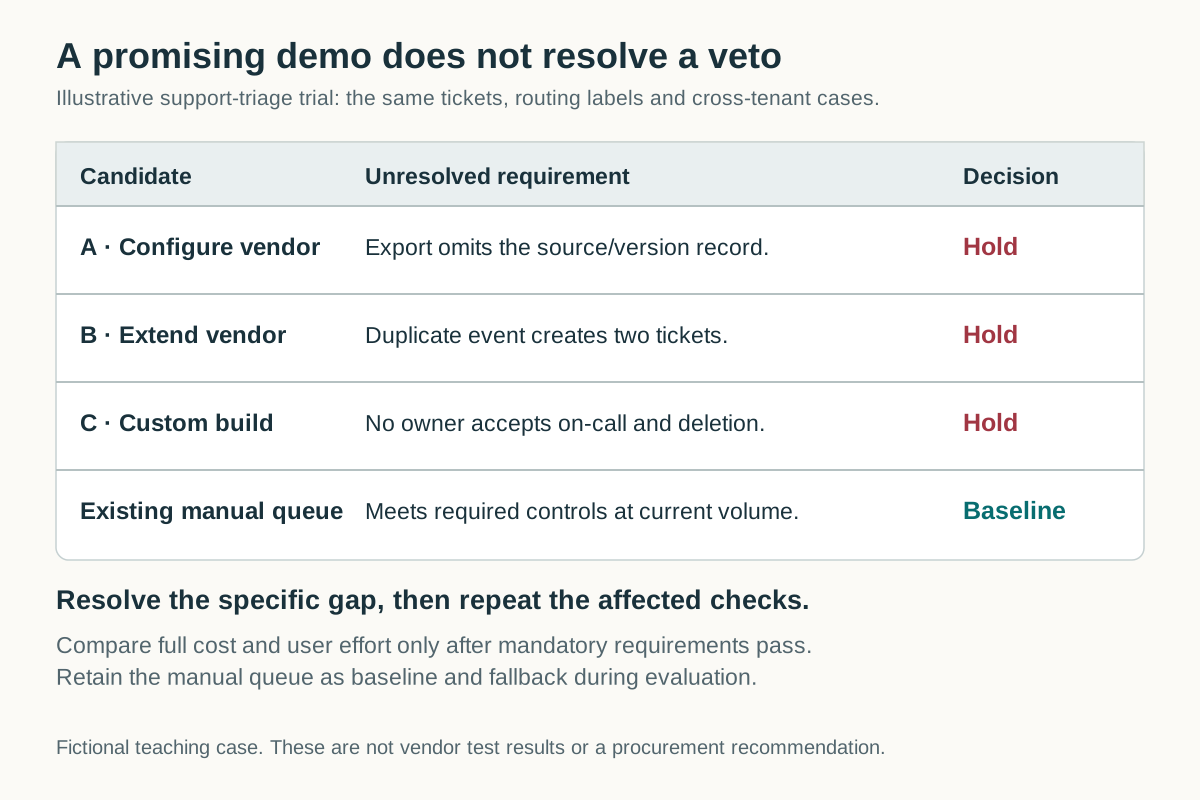
This invented support-triage comparison shows why a weighted score comes after mandatory requirements. All options receive the same synthetic tickets, expected routing labels and forbidden cross-tenant cases.
| Candidate | Trial observation | Decision at this stage |
|---|---|---|
| Configure vendor A | Routes correctly, but its required export omits the source/version record | Hold: audit requirement unresolved despite strong usability |
| Extend vendor B | Preserves source IDs; duplicate event test creates two tickets | Hold: extension recovery defect must be fixed |
| Custom build C | Passes the shown cases, but no owner accepts on-call and deletion operations | Hold: operating requirement unresolved |
| Existing manual queue | Meets required controls at current measured volume | Keep as baseline and fallback during further evaluation |
None is a winner because the demo looks promising. Resolve a candidate’s specific gap and repeat the affected tests; then compare full cost and user effort. If no option improves on the manual baseline enough to justify ownership, stop the procurement or build experiment.
Let the representative trial decide
The right AI build-vs-buy decision is evidence-specific. The UK government’s 2019 AI suitability guidance is an earlier public-sector reference for user needs, safe data use, build-or-buy integration and operating responsibility; it is not a current generative-AI comparison.
Use buy, configure, extend, build, and no-AI/manual paths as hypotheses. Select the lowest-ownership candidate that passes mandatory workflow, data, safety, integration, cost, accessibility, and exit requirements. The model and surrounding system can each be the limiting factor; the representative trial must show which one is.