Companion videos

Fine-tuning in 2026: an evidence-first LoRA and QLoRA experiment (companion videos)

The article plans an evidence-first LoRA or QLoRA experiment for 2026: justify adaptation on the task, profile the exact model and hardware configuration, then evaluate the adapter before release. Pair it with one long hands-on tutorial and one slower conceptual overview from a respected ML educator, and you should be able to decide both whether to fine-tune and how.

Primary pick

2:37:05
Fine Tuning LLM Models – Generative AI Course

freeCodeCamp.org

Long, theory-then-code course covering quantisation, LoRA, QLoRA, and full PEFT on Llama 2 and Gemma. It is the closest thing to a "shadow somebody who has done this" experience on YouTube and offers configuration-specific VRAM examples alongside the article's requirement to profile the selected hardware.

What you should get from this: Use the course's examples to study quantisation, LoRA and QLoRA fine-tuning. Verify the selected configuration's hardware requirements and evaluate your adapter before release.

Watch or know first: Python plus basic ML tooling comfort. Check the selected tutorial configuration's hardware and software prerequisites before running it.

AI Expert note: Model names, pricing and capabilities change quickly. The course's base models (Llama 2, Gemma) are dated, but the LoRA, QLoRA and quantisation techniques it teaches provide conceptual background for a separately evaluated experiment with a current model and configuration. Use this for the decision pattern, then verify current model behavior before adopting it.
Open video page

Also worth watching

58:45
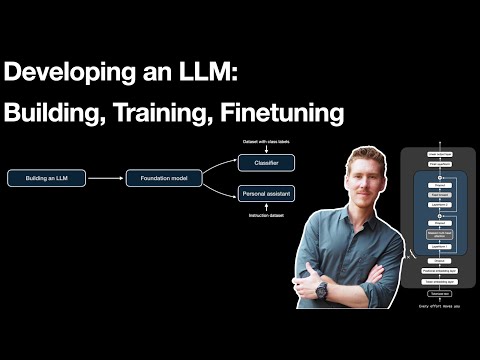
Developing an LLM: Building, Training, Finetuning

Sebastian Raschka

Sebastian Raschka's slower walkthrough of where fine-tuning sits in the broader LLM training pipeline: instruction tuning, classification fine-tuning, parameter-efficient methods, and the trade-offs the article asks you to assess against a simpler baseline, the available resources and a held-out evaluation. Good calibration before you start, especially if your team is debating whether fine-tuning is even the right step.

What you should get from this: Place fine-tuning inside the broader training pipeline and decide when it is better than prompting or RAG.

Watch or know first: General ML literacy; it's a conceptual walkthrough, so no code-along setup is needed.

AI Expert note: Model names, pricing and capabilities change quickly. Use this for the decision pattern, then verify current model behavior before adopting it.

Open video page