
Study groups can lose time to scheduling, unclear roles, and unstructured sessions. AI can format availability, rotate roles, and draft a recap from authorized notes. It should not become the group’s answer key: each member still needs an unaided attempt, and disputed answers must be checked against the course’s trusted sources.
What AI should coordinate
Every scheduling and recap prompt below sends other people’s information to a third-party vendor, and they did not choose that vendor. Use initials or “Member A” instead of full names, and describe availability as time windows only — do not paste anything that reveals where someone works, their shift pattern, childcare arrangements, health appointments, or home address, which is what “I’m free after I drop the kids off Tuesdays” quietly discloses. Ask the group once, explicitly, whether they are comfortable with their schedules and discussion contributions going through an AI tool at all, and honor a no. Under the GDPR, personal data means any information relating to an identifiable person (Regulation (EU) 2016/679, Article 4), and a shared study group is exactly the setting where one member’s convenience becomes four other people’s disclosure.
Scheduling across real constraints.
Here are the weekly availability windows for [N] group members, listed by initials only: [list each person's free time windows, no reasons attached].

Suggest 2-3 recurring weekly slots that work for everyone, or the largest subset if no slot works for all.
Flag whose availability is the binding constraint, so the group knows who to check with first if the schedule needs to change.
Rotating roles fairly.
A group may choose rotating roles — facilitator, question preparer, and recorder — to distribute coordination work. That is an optional operating pattern, not a claim that every group performs better with it. Ask AI to format the rotation only after the members agree:
We have [N] members and 3 roles: facilitator, quizmaster, recorder. We meet weekly for [X] weeks.
Build a rotation where everyone takes each role roughly equally, and no one repeats a role two weeks in a row.
Organizing the session recap from actual notes.
After a session, feed the group’s real discussion notes — not a description of what the topic “generally covers” — into AI for organizing, the same source-grounded principle used throughout this set:
Here are the raw notes from our study group session: [paste actual notes, questions raised, and answers the group settled on].

Organize this into a recap with: topics covered, open questions the group did not resolve, and each person's assigned follow-up for next week.
Do not add information about the topic beyond what is in these notes.
What AI should not become: the shared answer key
Do not let one member’s AI-generated answers become the group’s collective source of truth. If the question preparer distributes an answer key before anyone attempts recall, the design removes the opportunity to practise retrieval first — the risk described in what you may stop practising when AI starts every draft. This article does not predict how many members will remember the material or for how long. Experimental work found improved later retention from testing versus an additional study pass in the studied conditions (Roediger and Karpicke, 2006).
The fix is structural, not a matter of willpower: the quizmaster’s job is to prepare questions, not to distribute answers before the group has attempted them. Following the same source-grounded pattern from turning lecture notes into retrieval practice, each week’s quizmaster generates a question set from that week’s actual material, everyone answers individually before the session or at its start, and answers get revealed and discussed only after every member has made their own attempt.
A session structure that keeps the practice distributed
| Phase | Who does it | AI’s role |
|---|---|---|
| Pre-session prep | Quizmaster of the week | Generate source-grounded questions from that week’s material |
| Individual attempt | Every member, unaided | None — this is the part that must stay manual |
| Group discussion | Facilitator runs it | None during discussion; recorder takes raw notes |
| Recap | Recorder | Organize the raw notes into a shared document |
| Follow-up | Everyone, individually | Each member’s own AI use for their own weak areas, not shared |
The individual-attempt phase is the one row where introducing AI defeats the point of meeting as a group at all — a group exists so members can compare independently reached answers, not to distribute a single AI-generated answer to everyone at once.
Async and remote groups need the same discipline, applied to threads instead of sessions
Groups spread across time zones often coordinate asynchronously through a shared thread or channel rather than a live weekly call. The same structure still applies: AI can organize a scattered thread into a clean recap, but each member should post their own attempt before reading anyone else’s.
Here is our group's discussion thread for this week's topic: [paste the thread with names replaced by initials].

Organize it into: the question being discussed, each member's stated position under their initials, and where the group ultimately agreed or disagreed.
Do not resolve unresolved disagreements yourself - just report that they remain open.
Keeping “resolve unresolved disagreements” explicitly out of scope matters — the value of a study group is comparing independently reasoned answers, and a model quietly settling a disagreement for the group removes the exact discussion that would have caught a shared misunderstanding.
Using AI as a tie-breaker, correctly
When the group genuinely cannot agree on an answer after everyone has attempted it independently, AI can help — but only after the disagreement is on the table, not as a shortcut to avoid the disagreement in the first place:
Two group members reached different answers on this question: [question].
Answer A, with reasoning: [paste]. Answer B, with reasoning: [paste].

Based on [the source material/rubric], which reasoning holds up, and specifically where does the other answer's reasoning break down?
This uses AI to adjudicate an honest disagreement between two real attempts — a very different use from generating the group’s answer before anyone has attempted anything.
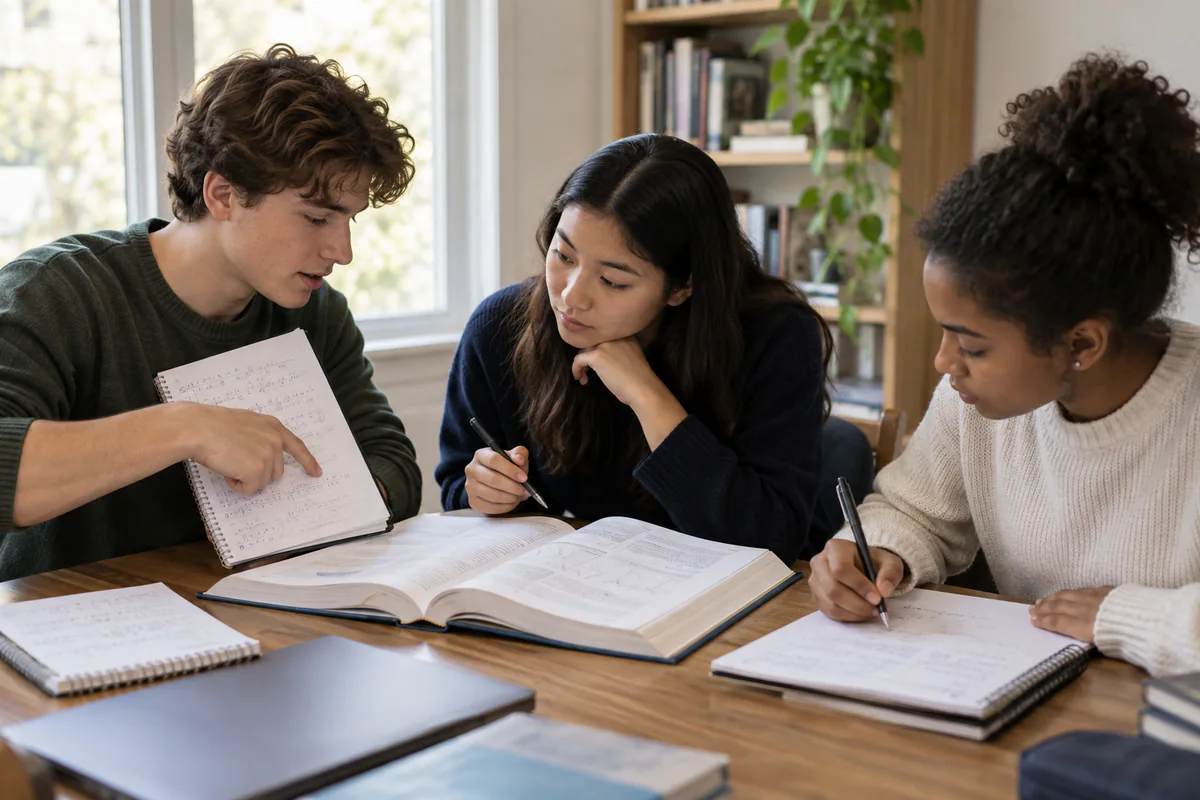
Group projects and academic integrity
If the study group is working toward a jointly graded assignment rather than independent practice, the same policy-first discipline from studying for an exam without crossing into cheating applies at the group level: check whether the assignment permits collaborative AI use, and whether disclosure of AI assistance is required for group submissions specifically. A group’s informal norm about acceptable AI use does not override the institution’s or program’s actual policy, and groups face a specific added risk — one member’s undisclosed AI-generated contribution becomes every group member’s problem if it surfaces later.
An illustrative week-3 slip
The following is an illustrative scenario, not a documented case. A five-person group preparing for a certification rotates the question-preparer role. One week, the questions and answers are shared together before the session; two members read the answers before attempting them. The design has removed unaided retrieval for those attempts. The structural fix is to share only questions before the session and reveal checked answers after members submit their own work.
What coordination cannot substitute for
AI removes real friction from running a study group — the scheduling headache, the uneven role distribution, the recap nobody wants to write. It does not remove the need for each member to actually attempt the material, and a group that quietly routes around that need with a shared answer key will feel more efficient right up until the actual exam or the actual conversation where the knowledge needs to be reproduced without a document in front of anyone.
Try it this week
Use the scheduling prompt to lock in a recurring slot from your group’s real availability. Set up the role rotation for the next several weeks. For the next session, have the quizmaster generate questions only — no answers — and require every member to attempt them before the group meets. The study group coordination sheet tracks the rotation, the pre-session individual attempts, and the recap in one place.