

Planning meals for a household with a food allergy is a logistics problem layered on top of a safety problem, and the two need to stay clearly separated. The logistics part — what to cook this week, given what is already known to be safe, what everyone likes, and how much time and money there is — is well suited to a model that can hold a long list of constraints and generate varied options without repeating the same three meals. The safety part — is this specific product actually free of this specific allergen today, is this substitution actually equivalent, does a symptom mean something needs a doctor — is not something a model can determine, and it should never be asked to.
This distinction matters because a fluent, well-formatted meal plan can create a false sense of thoroughness. A model that suggests “swap oat milk for dairy milk” is doing a plausible-sounding logistics move; it has no way to know if the specific oat milk brand in your kitchen was processed in a facility that also handles the allergen your household is avoiding, or whether an individual’s reaction profile makes that swap unsafe for reasons unrelated to the ingredient list. Logistics planning is not a safety determination. Every meal plan in this workflow starts from ingredients your household has already confirmed are safe — through medical diagnosis, allergist guidance, and label-reading — never from ingredients the model proposes as alternatives.
Do not ask a model to diagnose a reaction, suggest an elimination diet, recommend a substitution as “safe,” or make any nutrition or treatment decision. Packaging labels and a qualified medical professional (an allergist, a doctor, a registered dietitian) are the only sources that can confirm what is actually safe for a specific person — a model has no access to a product’s current manufacturing process, cannot see a label, and cannot verify a person’s individual reaction history. If a household member has a suspected but undiagnosed allergy, that is a conversation with a doctor, not a planning exercise.
A generated meal plan cannot determine whether a product, substitute, restaurant, or cross-contact control is safe. Follow the person’s written allergy plan and local emergency instructions; suspected anaphylaxis is an emergency, not a prompt.
Step 1: Build the verified-safe and do-not-use lists first — outside the model
Before any meal planning starts, write down the ingredients your household has already confirmed safe (through medical diagnosis, allergist guidance, and label-reading — not assumption) and the ones to avoid entirely. This list comes from your medical guidance and your own label checks, not from anything a model suggests.
Verified-safe ingredients: [list, e.g. rice, rice noodles, chicken,
carrots, olive oil, oat-based products from Brand X, Brand X soy-free
seasoning blend — each specifically checked against current
"may contain" statements]
Do-not-use, ever: [list the allergen and any related items your
allergist flagged, e.g. all tree nuts, any product with "may contain
peanuts"]
Household members and their specific restrictions: [list]
Step 2: Ask the model to plan logistics only, from your lists
Paste both lists and ask for a week of meals built strictly from the safe list, with variety, budget, and time as the only things the model is optimizing.
Using only these verified-safe ingredients [paste list] and never
these do-not-use items [paste list], plan 5 dinners for a household
of [N] with about [X] minutes of prep time on weeknights and [Y]
budget for the week. Vary the meals so we are not repeating the same
3-4 combinations. Do not suggest any ingredient not on my safe list,
even as an alternative or a "just a small amount" suggestion, and do
not suggest substitutions — if a recipe idea would need one, skip
that idea entirely.
Illustrative shape:
Monday: rice + roasted chicken + carrots + olive oil (15 min prep)
Tuesday: rice noodles + chicken + carrots + Brand X soy-free
  seasoning blend [all items already on the verified-safe list;
  still re-check the Brand X jar label at the store — see Step 3]
...
(Every ingredient in the illustrative plan must already appear on the Step 1 verified-safe list. If an idea would need something else, the model should skip that idea entirely — not invent a “close enough” substitute.)
Step 3: Every product still gets a label check, every time
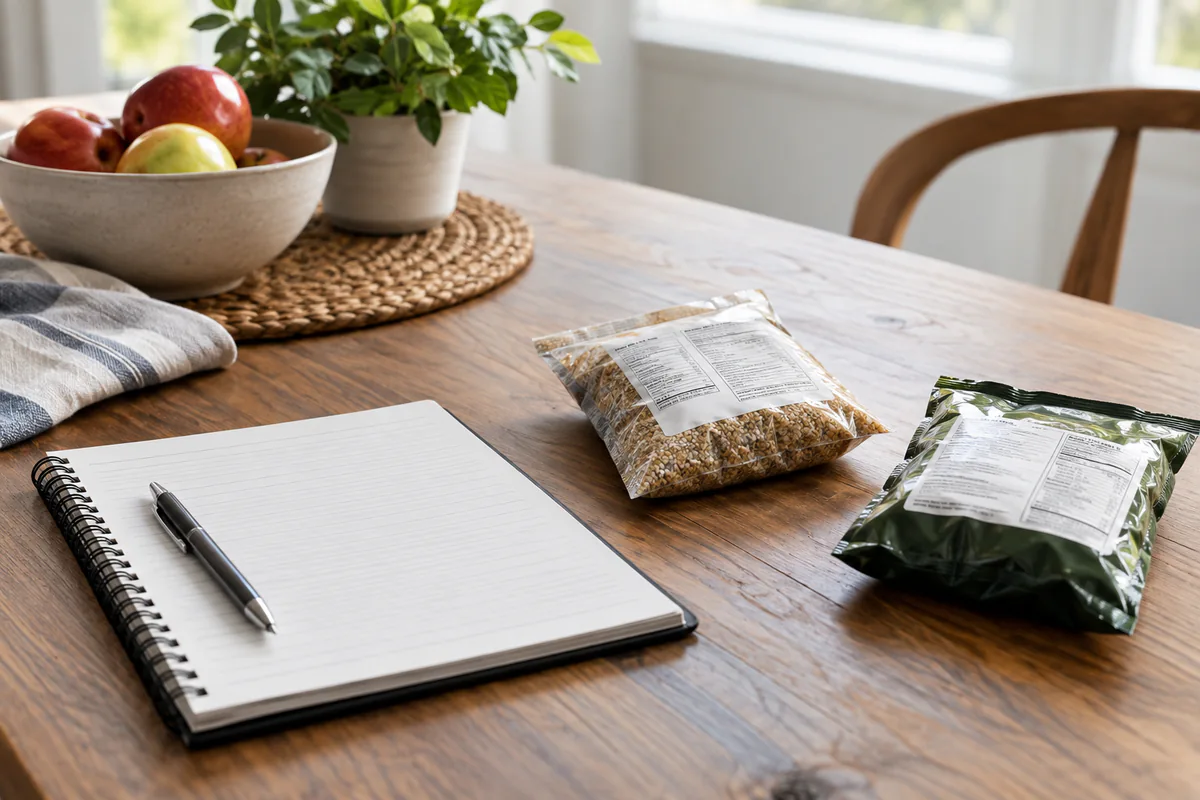
The model can name a category of product (“a soy-free seasoning blend”) but it cannot verify that the specific jar on the shelf this week matches last week’s jar — manufacturers change formulations and shared-facility statements without much notice. Build the label check into the shopping step as a non-negotiable habit, not an occasional double-check.
From this meal plan [paste], list every packaged or processed item
(not fresh produce or meat) that needs a label check at the store,
including any item I have bought safely before. Do not assume a
previously safe product is still safe — flag all of them for a
fresh check.
If a household member’s allergy details are documented for school, daycare, or an employer, keep that specific document (with names, dates of birth, or medical file numbers) out of any AI tool entirely — this workflow only needs the ingredient-level lists you write yourself, never a medical record.
Step 4: Map cross-contact points, then apply approved controls
A meal plan without a cross-contact plan is incomplete for an allergy household — shared cutting boards, shared toasters, and shared serving utensils can transfer allergens independently of the recipe. AI may help list where shared equipment appears in the workflow, but it must not invent or certify a control. Apply only controls from the person’s clinician-issued plan and current public-health or food-safety guidance applicable to the setting.
From this meal plan [paste], list every point where ingredients,
hands, surfaces, cutting boards, toasters, utensils, storage, or
serving items are shared with food containing [allergen]. Do not
decide whether a control is sufficient and do not declare any meal
safe. Leave a blank "approved control" field for us to fill only from
the person's written allergy plan or applicable food-safety guidance.
Assign a specific person to perform the label and cross-contact checks in the household process, and write down a fallback meal already approved under the household’s clinician-provided plan. “Fresh” or “unprocessed” does not automatically mean allergen-safe, so the fallback still follows the same sourcing, preparation, and approved cross-contact controls.
Evidence anchors for allergy safety
Use the person’s clinician-issued plan first. Official background sources include the FDA food-allergies overview, the FDA’s study of allergen transfer and cleaning methods in retail food settings, the European Commission’s food labelling and nutrition hub and food-information legislation overview, EFSA Safe2Eat allergens guidance, the NHS anaphylaxis guide, and the CDC’s food-allergy school resources. Labelling, precautionary statements, restaurant information, and emergency protocols vary by country and setting, and packaging can change; check the physical label every time and do not treat a model’s control list as validation.
Common pitfalls
- Letting the model suggest a new ingredient “as an option.” Even framed as optional, a suggested ingredient outside the verified-safe list can end up in the shopping cart if it is not filtered out at the planning stage.
- Assuming a previously safe product is still safe. Reformulations and shared-facility changes happen without warning; the label check applies every time, not just the first time.
- Skipping cross-contamination for “just this once.” The plan’s whole purpose is to make the controlled kitchen process the default every night, without relying on memory under time pressure.
- Treating a generated recipe as nutrition or medical guidance. This workflow is about logistics and variety, not about whether the diet meets a nutritional need — that question goes to a dietitian.
Validation and fallback
Confirm labels at the point of purchase rather than relying on a past shopping trip, and keep the person’s current clinician-provided emergency action plan accessible. If symptoms occur, follow that individualized plan immediately, including prescribed medication and emergency-service instructions exactly as written; do not use a chatbot to decide severity, medication timing, or whether help is needed.
Plan this week’s meals
Write out your verified-safe and do-not-use lists, then run the planning, label-check, and cross-contamination prompts above using the allergy-aware meal plan template. For the household-admin side of meal planning more broadly, AI for travel, recipes, and life admin covers the lower-stakes version of this workflow, and AI is not a doctor is worth reading as a reminder of where the model’s role in health questions ends.