Deep Research can gather sources and assemble a report across a broader question than a single search. Treat its result as a draft evidence map. The useful work is deciding what evidence the question needs, then checking whether the report’s claims are actually supported.
The current guides for ChatGPT deep research, Claude Research and Gemini Deep Research describe their own source and access options. Names, account access and connected services differ. This guide does not assume they see the same information or complete in the same time.
Decide whether research mode fits
Use it when the question requires collecting and comparing several sources. If the responsible page is already known, open that page. A narrow fee or deadline question does not become better answered by a long report.
Before the run, confirm which sources are enabled. Keep confidential plans and personal details out of unapproved tools, and do not connect private apps merely to enrich a public research question. ChatGPT data controls describe provider settings; your organization still decides which data and connections are permitted.
For consequential medical, legal, financial or compliance decisions, a research report is preparation for the appropriate authoritative process, not a replacement for it.
Specify the evidence, not just the length
A useful brief names the question, purpose, scope, date and required evidence. Here is a fictional software-selection task:
Compare three eligible booking tools for a small public workshop.
Must support: public class capacity, a waiting list, and export of bookings.
Use current vendor documentation and terms for features, plan eligibility,
export and price. Distinguish optional add-ons and annual billing.
Use independent user accounts only to identify questions about experience;
do not treat them as proof of contractual features or typical performance.
Return a claim table with source passages, dates, conditions and unknowns.
Do not recommend a purchase while a must-have requirement is unresolved.
Use public sources only. Mark inaccessible sources unread.
This asks for evidence that could support a comparison. It does not ask a model to infer suitability from company size, reputation or a listicle’s ranking.
Audit a claim that changes the recommendation
The following report and source excerpts are invented teaching material, not actual vendor claims or a product run.
| Item | Text |
|---|---|
| Draft report | “Tool A includes a waiting list on its standard plan.” |
| Cited feature page | “Waiting lists are available.” |
| Plan terms | “Waiting lists require the Events add-on.” |
The feature page alone does not support the plan claim. Correct the ledger to: “Waiting lists are available through an Events add-on; confirm its applicable price and availability.” Any cost table and recommendation based on inclusion must change too.
This is why checking three convenient citations cannot clear a whole report. Start with a few checks if you are screening quality, then verify every claim that could change the decision or published conclusion. NIST’s generative-AI profile identifies fabricated and misleading content as risks even when prose is fluent.
Read for scope, dates and missing evidence
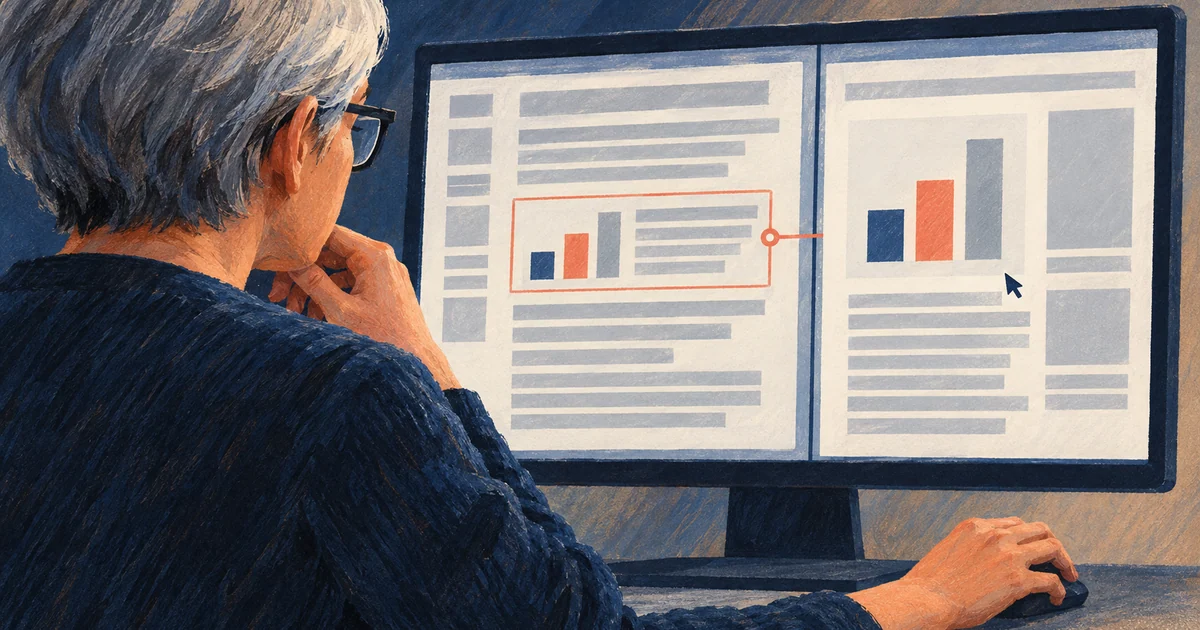
Open the supporting passage, not just the website’s home page. Check the product edition, country, period, denominator and exceptions relevant to the claim. A current page can describe a future release; a recent article can repeat old data.
Separate observed results from vendor promises and from the report’s inferences. User reviews may reveal a migration concern, but they do not establish a typical migration cost. A source you could not access remains unchecked; do not cite a search snippet as though the full document was read.
Ask which reasonable perspective or alternative the source set omitted. This is a coverage question, not a requirement to manufacture equal evidence for every position. Another AI critique can suggest gaps, but its objections also need source checks.
Write the final memo from the corrected ledger
Carry the support and limits into the shorter version. “Not documented” should not become “not supported by the product.” “Available with an add-on” should not become “included.” Where evidence is unresolved, name the vendor question or further research needed.
Use the source ledger to keep those distinctions visible. Finish with a conclusion proportionate to the evidence, even if that conclusion is that the available report cannot yet support the decision.