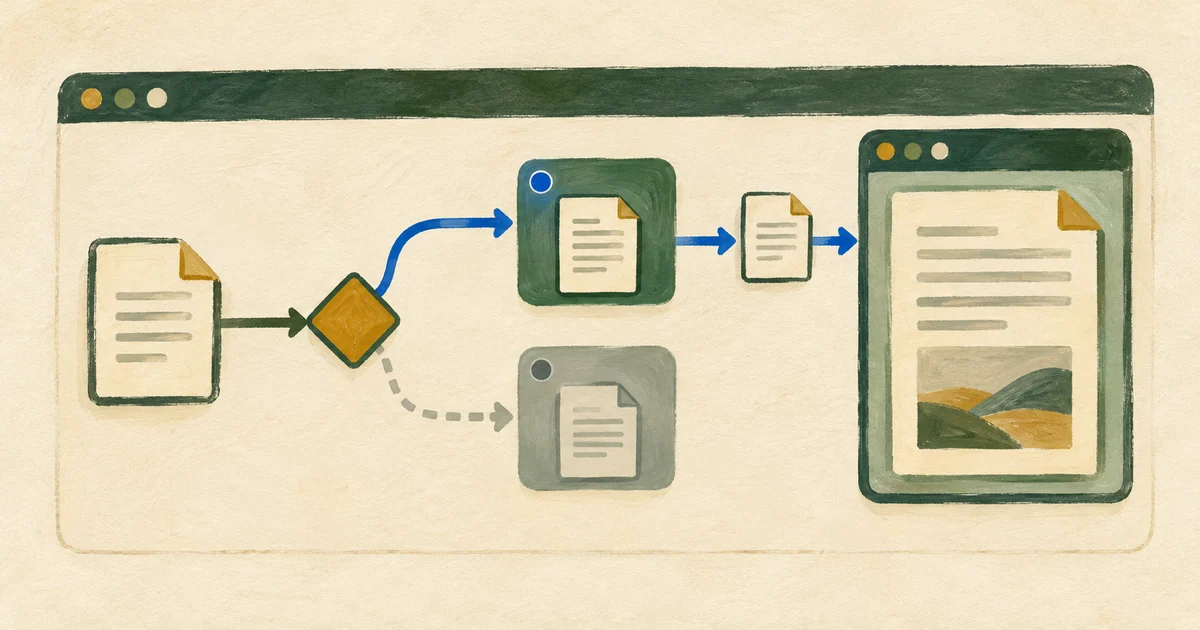
A daily or weekly AI briefing can reduce repeated scanning when it retrieves the right material and preserves links back to the sources. The benefit and reading time depend on the audience, coverage, and error rate; measure them instead of promising saved hours.
Done badly, it becomes another email you skip. The difference is in the architecture and, more importantly, the iteration.
This article presents a candidate architecture, acceptance criteria, and maintenance loop. Whether the briefing is worth reading must be measured with its actual audience.
Use the current n8n Schedule Trigger documentation for scheduling details. Before email delivery or tracking, map the actual audience and jurisdiction against official rules such as the UK’s electronic-mail marketing guidance; do not copy one jurisdiction’s consent or soft-opt-in rule into another.
The four jobs of a briefing
A useful AI briefing does four things, in order:
- Gather: pull content from many sources.
- Filter: keep only what matters to your specific audience.
- Synthesise: distill into a structured, scannable output.
- Distribute: deliver to the right place at the right time.
Each is a distinct concern. We’ll walk through each.
Job 1: Gathering
Start with sources whose access and reuse terms permit this workflow: publisher feeds, an approved API or directly reviewed public pages. A subscription, a public URL or a robots.txt allowance does not by itself establish permission to redistribute the material. For internal sources, the eventual briefing audience must be allowed to see every included item.
Give each source an ID, canonical URL, expected update pattern, access boundary and retrieval status. Store the source publication date separately from your retrieval time. An old article fetched today is not new reporting.
Treat collection failure as a coverage gap. If the principal regulator feed cannot be fetched, the briefing must not imply that no regulatory update occurred. Retain the failure and decide whether to delay, publish with a coverage note or omit the issue.
Expand the source set only when you can measure unique useful items and important omissions. A low-volume official source can be essential even if it rarely supplies a headline.
Job 2: Filtering
Filtering determines what can be omitted as well as included. Measure both false inclusions and important omissions; a shorter briefing is not necessarily a better one.
Three approaches, often combined:
Approach 1: Keyword and metadata filtering
Cheap, fast, transparent. Filter by:
- Keywords in title or body.
- Publication date (last 24 hours, last week).
- Source tier.
- Categories or tags from the source.
This catches the obvious. It also misses subtle relevance.
Approach 2: Embedding-based filtering
For each item, compute a vector embedding. Compare to a vector representing “what I care about” (built from past interesting articles or a description of your interests). Keep items above a similarity threshold.
This may retrieve related wording missed by literal keywords. Similarity can also select irrelevant material, so evaluate it against the same labeled inclusion and omission cases.
Approach 3: LLM-based filtering
For each item that passed the cheap filters, run a small LLM call:
You are filtering content for a daily briefing aimed at [audience description].

Given this article title and the first 300 words, score it 1-10 on relevance to the audience, and produce one sentence on why it might (or might not) interest them.

Output JSON: {"score": <1-10>, "reason": "<one sentence>"}

Article:
[title and excerpt]
Keep items above a threshold calibrated on representative human labels. Do not assume an LLM filter is the most accurate or that a score of 7 has stable meaning across models, prompts, sources, or languages.
A candidate cascade is a transparent metadata/keyword filter, then an embedding or model-based classifier for unresolved items. Compare it with simpler alternatives on the same labelled set; extra stages can add latency, cost, correlated errors, and missed items.
Job 3: Synthesis
Once you have a reviewed candidate set, the synthesis step can produce a draft. Limit item count from the model context, reader needs, and measured omission risk rather than a universal daily range.
A strong synthesis prompt:
You are producing a daily briefing for [your audience description].

You have been given [N] articles that passed our relevance filter. Produce a briefing with this structure:

**Lead items.** Up to the configured number of verified relevant items; do not fill empty slots. For each:
- One-line title (your headline, not the source's)
- Two-sentence summary
- The source link
- One sentence on "why this matters" for our audience

**Quick reads.** Remaining verified items that add distinct information, if any:
- One sentence each
- Source link

**Skim or skip.** Items in the borderline zone, just titles + links. Reader decides if interesting.

**Patterns this week.** (Weekly briefing only) Any themes connecting the week's stories.

Tone: direct, no preamble, no "here's your briefing today." Get straight into content.

Use [my inference] for anything you're extrapolating beyond the source material.

Do not invent quotes or numbers. If you reference a statistic, cite which article.

Articles:
[approved source excerpts with source IDs, dates, coverage status and usage limits]
This prompt requests a structured draft; it does not guarantee accurate summaries, complete coverage, or useful ranking. Preserve source links and require review of claims, quotations, numbers, and material omissions before distribution.
A few variations worth knowing:
-
Audience-aware framing. Different briefings need different angles. A briefing for engineers should emphasise technical implications; for executives, business implications; for journalists, news value. The “audience description” line shapes the synthesis significantly.
-
Themed sections. For a specific-topic briefing (e.g., “AI safety news”), organise sections by sub-topic rather than top/quick/skim.
-
Comparison and contradiction surfacing. “If multiple sources report on the same event, surface where they disagree.” Catches the interesting friction.
-
Calibrated certainty. “Label a claim supported by only one inspected source as [single-source].” The label describes provenance; it does not validate the claim.
Job 4: Distribution
The last step is delivery. A briefing that lands in the wrong place at the wrong time is worse than no briefing.
Practical questions:
Where? Choose an approved channel that matches access control, retention, consent, delivery evidence, accessibility, and reader preference. Email, chat, RSS, or a workspace page carry different obligations.
When? Ask readers when and where they want the briefing, account for time zones and quiet hours, and test delivery timing. There is no universal morning window.
How frequently? Set cadence from meaningful source volume and reader demand. Change or pause it when the result is repeatedly empty, duplicative, stale, or unread.
Personalisation. If you’re producing a briefing for multiple readers, consider light personalisation: different sections for different roles, different “top 3” based on their stated interests, different sources weighted differently.
The architecture
Putting it together, a typical briefing system looks like:
[Scheduled trigger: audience-approved cadence and time zone]
    ↓
[Fetch sources in parallel: RSS, APIs, scrapers]
    ↓
[Deduplicate: remove articles already covered]
    ↓
[Filter tier 1: keep all]
[Filter tier 2-3: keyword + embedding + LLM scoring]
    ↓
[Rank by score]
[Take the configured top N from reader, context, cost, and omission tests]
    ↓
[Synthesis from permitted excerpts and source IDs]
    ↓
[Claim, coverage and recipient-access check; stop on failure]
    ↓
[Idempotent delivery to approved recipients]
    ↓
[Log approved operational metadata and controlled review samples]
The implementation may be an automation platform or a custom service. Decide from authentication, source connectors, state, deduplication, observability, review, delivery, and support requirements, not audience size alone.
A practical setup in n8n:
- Schedule trigger at the approved delivery time (the current n8n node name and scheduling semantics are version-dependent).
- RSS Read nodes for each tier-1 source.
- HTTP Request nodes for any custom APIs.
- Merge all items into a single list.
- Code node for deduplication (by canonical source identity and content hash) against a retention window selected from the publishing cadence and source behavior.
- Approved model or classifier node that processes each eligible item with the evaluated scoring contract.
- Filter using the threshold calibrated on the labelled evaluation set; do not hard-code
7from this example. - Aggregate only the permitted excerpts and metadata needed for the issue.
- Approved model node for the synthesis prompt.
- Review gate checks claims, coverage, recipient permissions and current distribution approval.
- Delivery uses an issue/recipient key and records the provider result. Reconcile an unknown send outcome before retrying.
Build and test each stage separately. Setup time depends on authentication, source formats, deduplication state, and delivery controls. A schedule firing successfully is not proof of a healthy briefing: alert on collection failures, empty inputs, model errors, duplicate volume, delivery failure, and unusual cost.
The discipline: keeping it worth reading
During the bounded pilot, review each issue for false inclusions, important omissions, unsupported claims and missing updates. Measure against an independently reviewed source set, not only what the filter happened to select.
Ask readers which item changed a decision or saved a source visit, and record correction work. Opens and clicks are incomplete proxies: previewing, privacy features and reader behavior can distort them, and tracking itself needs approval. Do not turn a lower open rate into an unsupported diagnosis that the content became worse.
Maintain explicit duplicate and exclusion rules, but let revised source material reopen a previously covered event. A correction is not a duplicate to suppress. Recheck when the model, prompt, source format, access terms or audience changes.
The stop control must block delivery outside the model. Empty content, unreviewed high-impact claims, lost source coverage or an unknown previous send outcome should produce a held issue, not filler or a blind resend.
A worked example: an AI industry briefing
This invented issue has three source records. They illustrate the ledger, not actual news:
| Source record | Retrieved statement | Editorial disposition |
|---|---|---|
| S1: vendor release note, revision 2 | Feature X is available to a limited preview group | Include, preserving preview scope |
| S2: commentary linking to S1 | Feature X is “available to everyone” | Do not treat as independent confirmation; flag contradiction |
| S3: official service-status feed | Retrieval failed | Coverage unknown; retry or label the gap |
A supported author-written item is: “Feature X entered limited preview, according to the vendor’s revision 2 release note.” “Feature X has launched generally” fails the scope check. S2 adds no verified independent evidence for the broader claim.
The issue record links that sentence to S1 and notes why S2 was excluded. If S1 is later corrected, its revision identifier makes the affected issue findable. The source outage stays visible to the reviewer even if the final item is accurate.
Before delivery, the gate checks the permitted audience and whether this issue was already accepted by the delivery provider. If the provider times out after a possible send, hold the retry until its status is reconciled. The briefing issue record keeps selection, coverage and delivery evidence together.
Build it, then tune it against evidence
A briefing is an operated information product, not a permanent asset. The architecture is gather, filter, synthesise, and distribute; the production work is source permission, provenance, monitoring, privacy, delivery compliance, and ongoing evaluation.
Retain every item’s canonical URL, title, publisher, publication date, retrieval time, and usage rights/terms where relevant. Summarise rather than republishing source text, respect access controls and site/API terms, and have counsel review a commercial aggregation product. For subscriber delivery in Europe, review applicable direct-marketing, GDPR, and ePrivacy obligations; editorial review is not legal clearance.
Pick a topic, define an acceptance set and stop conditions, run the briefing initially to internal reviewers, and expand distribution only after measured usefulness and failure handling are acceptable.